
(c) Simon BA Gemmill
The Unified Navigation & Control Console is an advanced browser-based simulation system that merges multiple technologies into one interactive interface. It combines a process simulator, AI decision engine, vehicle HUD, and navigation system into a single, real-time updating dashboard.
Designed with a futuristic aesthetic and modular architecture, the program demonstrates how AI logic, mathematical processing, and UI visualisation can work together seamlessly in a live environment.
⚙️ Core Features
🤖 AI Vehicle Decision System
At the heart of the program is an intelligent selection engine that evaluates multiple vehicles based on:
- Efficiency (performance score)
- Reliability (durability score)
- Insurance cost impact
- Overall calculated score
The system automatically selects the optimal vehicle each cycle using a weighted scoring algorithm, simulating real-world decision-making.
🔢 Dynamic Process Simulator
The simulator continuously generates and solves equations of the form:
A + A₁ − X = Y
Key elements:
- Randomised variables for continuous variation
- Binary conversions of all values
- Alphabet mapping (A → Z progression)
- Logical state outputs (e.g., boat states, cable processes)
This creates a mathematical + symbolic processing engine that evolves in real time.
📊 Electric HUD (Heads-Up Display)
The HUD provides a live system readout including:
- Loop count and progression
- Alphabet tracking (A → Z cycles)
- Binary, octal, and positional values
- Reverse indexing logic
- Data logging panel
It acts as the analytical brain of the system, reflecting internal state changes.
🧭 Navigation & Compass System
A visual navigation module simulates movement and direction:
- Circular progress ring (distance tracking)
- Rotating compass needle (bearing)
- Coordinate display (current → target)
This gives the program a spatial awareness layer, linking data to motion.
🚦 Traffic Light Simulation
Two independent traffic systems simulate real-world signalling:
- Red / Amber / Green cycles
- Timed state changes
- Visual feedback with glow effects
Useful for modelling control systems and timing logic.
💻 AI Phone OS + Currency System
A secondary subsystem mimics a lightweight operating system:
- Progress bar with AI status messages
- Incremental currency generation
- Bitcoin-style micro accumulation
- Data logging panel
This adds a digital economy simulation layer.
🌐 Real-Time Loop Engine
The entire system is powered by a continuous loop:
- Runs every 2 seconds
- Updates all modules simultaneously
- Maintains shared system state
This ensures synchronised behaviour across all components.
🔄 Processes & System Flow
- Loop starts
- AI evaluates all vehicles
- Best vehicle is selected
- Mathematical process executes (A + A₁ − X = Y)
- Values convert to binary, octal, and alphabet
- HUD updates with new state
- Navigation + traffic systems refresh
- Currency and AI OS increment
- Loop repeats
This creates a closed-loop simulation ecosystem where every component feeds into the next.
✅ Advantages
- All-in-one system – Combines AI, maths, UI, and simulation
- Real-time updates – Everything runs live and synchronised
- Highly visual – Easy to understand complex processes
- Modular design – Components can be expanded independently
- Educational value – Demonstrates:
- Binary systems
- AI scoring logic
- State machines
- Real-time programming
⚠️ Disadvantages
- Randomised logic – AI decisions are simulated, not data-driven
- Performance scaling – Could slow down with more complex features
- No persistence – Data resets on refresh
- Frontend-only – No backend or real-world data integration
- Complex structure – Harder to maintain as it grows
🚀 Final Thoughts
This project showcases a powerful concept:
bringing together AI decision-making, mathematical simulation, and interactive visual systems into a single unified environment.
It’s not just a simulator—it’s a foundation for future intelligent systems, where multiple subsystems communicate, evolve, and adapt in real time.
-
🚗 Unified Navigation & AI Process Simulator – Blog Overview
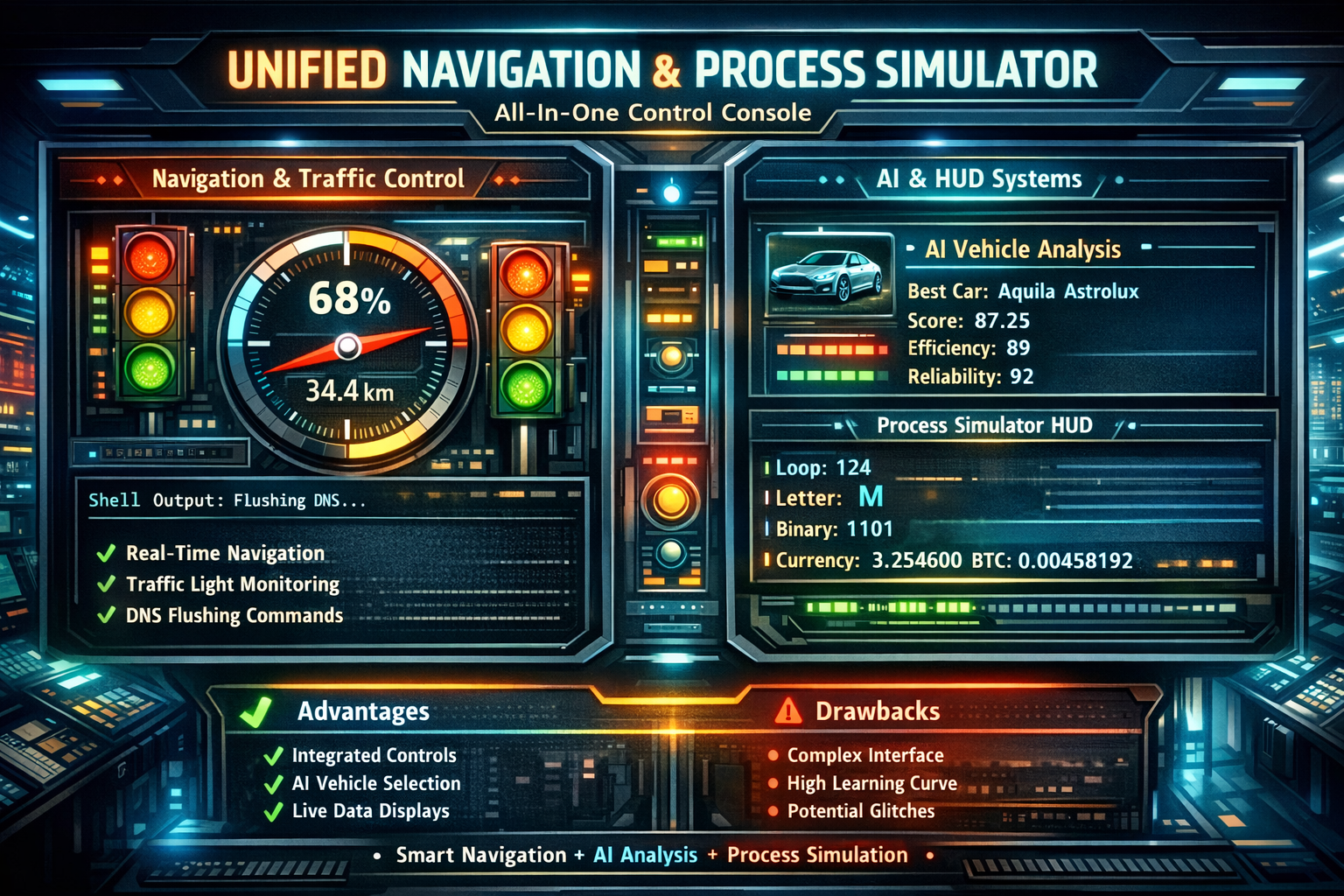
The Unified Navigation & Control Console is an advanced browser-based simulation system that merges multiple technologies into one interactive interface. It combines a process simulator, AI decision engine, vehicle HUD, and navigation system into a single, real-time updating dashboard.
cars Causality Clocker SAS Featured Future Computing Grandfather Paradox how time travel works html influence is time travel possible Java Mission 2127 Orbital Computing planes Project Suncatcher python python time travel Quantum Realities: Quantum Theory science of time travel Space AI Space Technology Timeline time travel time travel explained time travel physics time travel theory trains Unraveling the Mysteries of Modern Physics


Leave a Reply