
SEO title: Clocker SAS Mission to 2126 | A Journey Into the Future
Meta description: Join Clocker SAS on a fictional mission to 2126 as a team of time travellers discovers a future very different from the one they expected.
Keywords: Clocker SAS, 2126, future, time travel story, time travellers, science fiction
Category: Clocker SAS / Fiction
Tags: Clocker SAS, 2126, Future, Time Travel, Adventure, Science Fiction
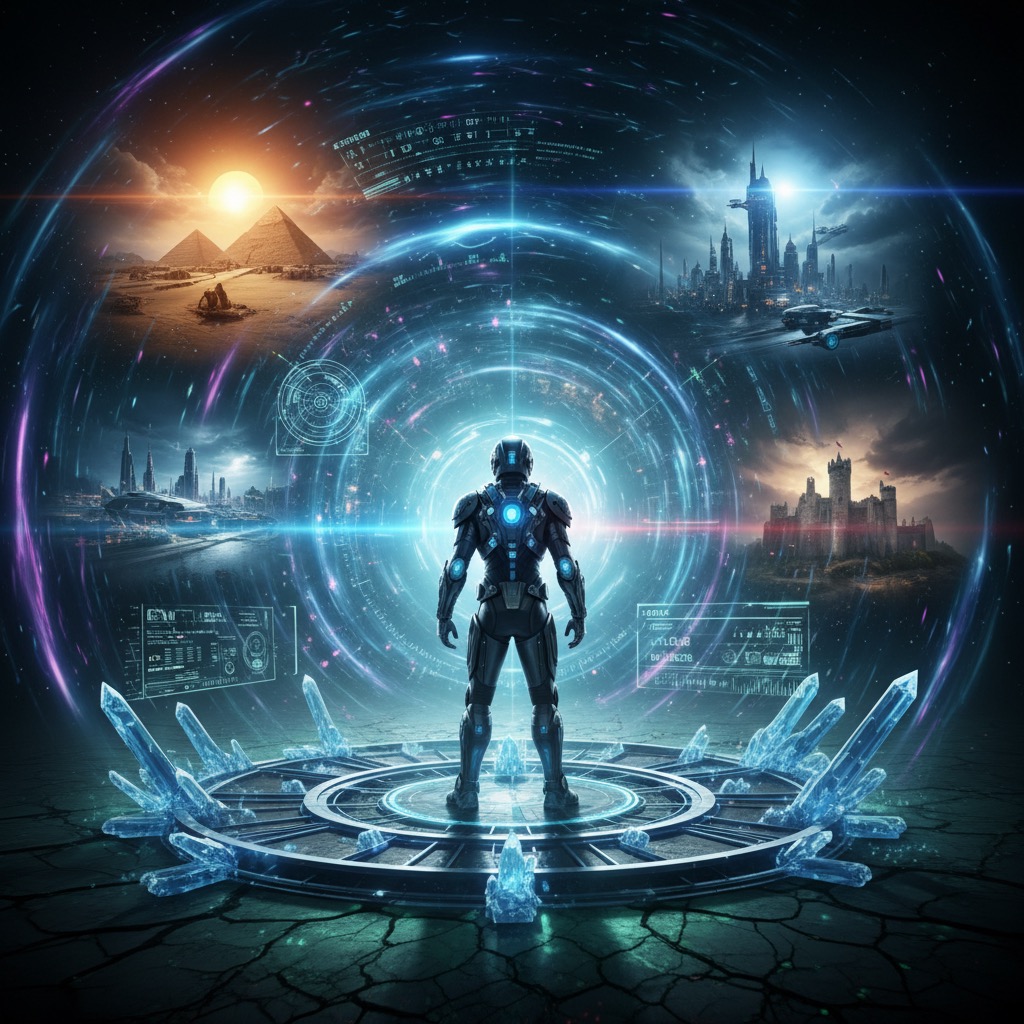
Suggested featured image: A futuristic city in 2126 with a time-travel portal opening in the foreground.
The Clocker SAS Mission to 2126
A journey into a future nobody had seen — and a mission that would change everything the Clocker SAS team thought they knew about humanity.
The Year Was 2126
The control room was silent.
Outside the reinforced observation windows, the Clocker SAS research facility stood beneath a darkening sky. Thousands of lights stretched across the horizon, but tonight the city below was almost completely silent.
Inside the laboratory sat the most ambitious machine ever constructed by the fictional Clocker SAS organisation.
It had taken decades to design.
The destination had been calculated thousands of times.
The year was already programmed into the navigation system.
Destination: Earth — Year 2126.
Mission: Observe humanity’s future and return safely.
At precisely 23:00, Commander Alex Morgan looked around the chamber.
“Are we really going to do this?”
Nobody answered.
They did not need to.
The Clocker
The machine did not resemble the traditional time machines of twentieth- and twenty-first-century science fiction.
There was no giant spinning dial and no single red button labelled TIME TRAVEL.
Instead, the Clocker was a vast circular chamber surrounded by precision instruments, quantum sensors, computers and energy-management systems.
At the centre was a circular platform.
That platform was where the six-person mission team would stand.
The machine’s fictional navigation computer displayed one final warning:
“Temporal destination confirmed. Year 2126. Return coordinates locked.”
Commander Morgan smiled.
“Let’s see what the future did with us.”
Temporal Gateway — 2126
The Jump
The countdown began.
10… 9… 8… 7…
The laboratory lights dimmed.
The instruments around the chamber began glowing blue.
At six seconds, the team felt something strange.
At five seconds, there was no sound.
At four seconds, the clocks stopped.
At three seconds, the world outside the windows appeared to stretch.
At two seconds, Commander Morgan could no longer see the laboratory.
At one second —
THE FUTURE.
Then everything returned.
Welcome to 2126
The first thing Commander Morgan noticed was the sky.
It was clear.
Almost unnaturally clear.
The second thing was the city.
It was enormous.
Towering buildings stretched upward like glass mountains. Transport systems moved silently between structures. Green spaces covered rooftops and enormous vertical gardens climbed the sides of buildings.
But there was something missing.
Traffic.
The streets below were almost empty.
Instead, most transportation appeared to be underground or airborne.
A City Without Traffic
The First Surprise
The team expected advanced technology.
They expected robots.
They expected artificial intelligence.
What they did not expect was how ordinary much of life still seemed.
People were walking through public gardens. Children were playing. Restaurants were open. Music could be heard from a nearby plaza.
Technology had changed almost everything — but people were still people.
“The future didn’t replace humanity. It simply gave humanity new tools.”
Artificial Intelligence in 2126
The Clocker SAS team soon discovered that artificial intelligence had become deeply integrated into everyday life.
AI systems helped manage transport networks, energy supplies, medical facilities, agriculture and scientific research.
But the team noticed an important difference.
AI was not necessarily visible.
There were no robots standing on every street corner.
Instead, intelligence had become infrastructure.
It was built into buildings, vehicles, communications systems and public services.
The 2126 Principle
The most powerful technology was often the technology people barely noticed.
The Spaceport
On the second day of the mission, the team travelled to a spaceport.
The facility was unlike anything they had seen in their own century.
Large spacecraft rested inside enormous launch structures.
One destination immediately caught their attention:
MARS — 17 DAYS
Commander Morgan stared at the display.
In their own time, humans had dreamed of permanent settlements beyond Earth. Now, according to the fictional 2126 timeline, regular missions between Earth and Mars were part of a growing transportation network.
But the most remarkable discovery was not Mars.
It was the destination listed underneath it.
LUNAR ORBIT — 9 HOURS
A Message From the Future
Before the Clocker team could leave the spaceport, an automated information system approached them.
It recognised their temporal signature.
The team froze.
Someone — or something — knew they had travelled from the past.
“You should not be here.”
Commander Morgan stepped forward.
“Who are you?”
The answer appeared on the display.
“I am the guardian of historical continuity.”
Nobody spoke.
The Clocker mission had been designed to observe the future.
They had not considered that the future might be observing them.
The Temporal Secret
The guardian revealed something the Clocker team had never known.
Their mission had happened before.
Not once.
Hundreds of times.
Different teams had travelled into the future attempting to discover what humanity would become.
Some had returned.
Some had disappeared.
And some had apparently changed the future simply by observing it.
Commander Morgan suddenly understood the danger.
The Mission Rule
Observe the future.
Do not change the future.
But the team had already broken the first rule of time travel: they had arrived.
The Decision
The Clocker team had two choices.
They could return immediately to their own time and report what they had seen.
Or they could remain in 2126 and investigate the mysterious guardian.
The mission clock was already counting down.
Their return window would not remain open indefinitely.
Commander Morgan looked at the team.
“We came here to discover the future. Now the future has given us a question.”
The team entered the Clocker’s return coordinates.
But before the machine activated, the guardian sent one final message.
“Do not bring the future back with you.”
Then the system disappeared.
The Return
The Clocker activated.
2126 vanished.
The city disappeared.
The spaceport disappeared.
The strange guardian disappeared.
The laboratory returned.
The clocks restarted.
Only seven seconds had passed.
Commander Morgan looked at the mission clock.
Seven seconds.
But the team had spent three days in the year 2126.
Something had changed.
On the main computer screen was a file that had not existed before the mission.
CLOCKER SAS — MISSION 2126
STATUS: RETURNED
Underneath was a single line.
“Mission 2126 was successful. Do not attempt Mission 2127.”
Commander Morgan stared at the message.
Then another line appeared.
MISSION 2127 ALREADY UNDERWAY.
What Could the Future Really Look Like?
The Clocker SAS mission is fiction, but many of the technologies imagined in this story are connected to real areas of research.
- Artificial intelligence and machine learning
- Advanced robotics
- Autonomous transport
- Space exploration
- Renewable and advanced energy systems
- Quantum computing
- Atomic clocks and precision timing
- Advanced communications
The exact world of 2126 cannot be known today. Predictions about a century into the future are inherently uncertain.
That uncertainty is what makes science fiction interesting: it allows us to ask what might happen without pretending that the answer is already known.
Fiction Meets Science
The Clocker SAS story builds upon genuine scientific ideas about time, space, relativity and future technology, but the actual mission to 2126 is entirely fictional.
There is currently no demonstrated technology that allows people to travel forward or backward through time at will, and Clocker SAS is a fictional organisation created for this story universe.
Final Transmission
The Clocker team had gone looking for humanity’s future.
Instead, they discovered something far more disturbing.
The future already knew they were coming.
And somewhere, in a hidden laboratory beneath the cities of 2126, another Clocker was already counting down.
10… 9… 8…
To be continued…
Real-World Resources & Further Reading
The story is fictional, but readers interested in the real science and technology behind the ideas can explore the following resources:
-
NASA — Time Travel
NASA Space Place explains the scientific concepts behind time travel, including relativity and time dilation.
https://spaceplace.nasa.gov/time-travel/en/ -
NIST — Atomic Clocks
The National Institute of Standards and Technology explains how atomic clocks measure time using extremely precise atomic transitions.
https://www.nist.gov/atomic-clocks -
NASA — Mars Exploration
Explore NASA’s current and planned research into Mars and human exploration.
https://mars.nasa.gov/ -
NASA — Artemis
NASA’s Artemis programme provides information about lunar exploration and future human missions around the Moon.
https://www.nasa.gov/artemis/ -
NASA — Artificial Intelligence
NASA uses artificial intelligence and machine learning across a variety of research and exploration activities.
https://www.nasa.gov/learning-resources/artificial-intelligence/
Image credit: The futuristic city and Clocker SAS temporal gateway shown in this article are fictional conceptual imagery. If a generated image is used as the featured image, it should be identified as conceptual artwork rather than a photograph or representation of real technology.
Editorial note: Clocker SAS, the 2126 mission, the characters, the temporal guardian and the events described in this article are fictional. Real-world scientific and technology references are included to provide background and inspiration only.
cars (1) Causality (1) Clocker SAS (1) Featured (8) Future Computing (1) Grandfather Paradox (1) how time travel works (1) html (1) influence (1) is time travel possible (4) Java (8) Mission 2127 (1) Orbital Computing (1) planes (1) Project Suncatcher (1) python (9) python time travel (9) Quantum Realities: (1) Quantum Theory (1) science of time travel (16) Space AI (1) Space Technology (2) Timeline (1) time travel (18) time travel explained (14) time travel physics (3) time travel theory (12) trains (1) Unraveling the Mysteries of Modern Physics (8)
- Category 1 (1)
- Category 2 (1)
- Category 3 (1)
- New time-travel.space (20)
- Time Travel (18)
- Quantum Theory (1)
- Science & Technology (16)
- Time Travel (18)
-
The Clocker SAS Mission to 2126
SEO title: Clocker SAS Mission to 2126 | A Journey Into the Future Meta description: Join Clocker SAS on a fictional mission to 2126 as a team of time travellers discovers a future very different from the one they expected. Keywords: Clocker SAS, 2126, future, time travel story, time travellers, science fiction Category: Clocker SAS / Fiction Tags: Clocker SAS,…
Leave a Reply