
Unraveling the Mysteries of
Modern Physics
Chapter 1: Introduction to Quantum Physics
Historical Context of Quantum Mechanics
The historical context of quantum mechanics is deeply rooted in the early 20th century, a time when classical physics began to show limitations in explaining the behaviour of matter and energy at atomic and subatomic levels. Scientists like Max Planck initiated this revolution with his quantum hypothesis in 1900, proposing that energy is quantised, which laid the groundwork for the development of quantum theory. This marked a significant departure from classical notions, paving the way for a new understanding of physical phenomena.
In 1905, Albert Einstein further advanced quantum ideas by explaining the photoelectric effect, demonstrating that light can behave as both a particle and a wave. His work suggested that particles of light, or photons, possess quantised energy levels, which was a radical shift from the traditional view of electromagnetic radiation. This duality of light became a cornerstone of quantum mechanics and highlighted the necessity for a new theoretical framework that could accommodate these phenomena.
The 1920s heralded the formulation of quantum mechanics as a formal theory, with key contributions from physicists such as Niels Bohr, Werner Heisenberg, and Erwin Schrödinger. Bohr’s model of the atom introduced the concept of quantised energy levels, while Heisenberg’s uncertainty principle challenged the deterministic worldview of classical physics. Schrödinger’s wave equation provided a mathematical formulation that described the behaviour of quantum systems, leading to a deeper understanding of atomic structure and interactions.

As quantum mechanics evolved, it encountered philosophical implications that sparked debates among scientists and thinkers. The notion of superposition, where particles exist in multiple states simultaneously, and entanglement, where particles remain interconnected regardless of distance, posed questions about reality and observation. These discussions not only influenced the scientific community but also permeated popular culture, inspiring works of literature, film, and art.
The development of quantum mechanics has profoundly impacted modern physics, influencing various fields such as chemistry, material science, and information technology. It has led to innovations like semiconductors, lasers, and quantum computing, illustrating the practical applications of quantum principles. Understanding the historical context of quantum mechanics enables students and researchers to appreciate the transformative journey of physics as it continues to unravel the mysteries of the universe.
Key Concepts and Terminology
In the realm of quantum physics, certain key concepts and terminology serve as the backbone for understanding its principles. One of the most fundamental ideas is that of a quantum state, which encapsulates all the information about a physical system. This state can be represented mathematically as a vector in a complex vector space, illustrating the intricate nature of particles at the quantum level. Understanding quantum states is crucial for delving into more advanced topics such as superposition and entanglement, which are pivotal in the study of quantum mechanics.
Another essential term is the wave function, a mathematical function that describes the quantum state of a system. The wave function contains all the probabilistic information regarding the position and momentum of a particle, and its evolution over time is governed by the Schrödinger equation. The interpretation of the wave function has sparked numerous debates within the physics community, particularly concerning its implications for reality and measurement in quantum mechanics. This concept is often illustrated through thought experiments, such as Schrödinger’s cat, which challenge our classical intuitions about observation and existence.

Entanglement is a phenomenon that occurs when two or more quantum particles become linked, such that the state of one particle cannot be described independently of the others, regardless of the distance separating them. This concept defies classical intuitions about separability and locality, leading to what Einstein famously referred to as “spooky action at a distance.” Entanglement has profound implications for quantum information science, including quantum computing and quantum cryptography, where the unique properties of entangled states are harnessed for practical applications.
The principle of superposition is another cornerstone of quantum theory, asserting that a quantum system can exist in multiple states simultaneously until measured. This principle underlies many quantum phenomena and is essential for understanding how quantum bits (qubits) function in quantum computing, where they can represent both 0 and 1 at the same time. The phenomenon of superposition challenges classical notions of reality and highlights the probabilistic nature of quantum mechanics, forcing physicists to reconsider the deterministic frameworks of classical physics.
Finally, concepts such as quantum tunnelling and uncertainty play critical roles in the broader understanding of quantum mechanics. Quantum tunnelling allows particles to pass through potential barriers that they classically would not be able to surmount, leading to applications in nuclear fusion and semiconductor technology. The uncertainty principle, formulated by Heisenberg, states that certain pairs of physical properties, like position and momentum, cannot be simultaneously known with arbitrary precision, introducing a fundamental limit to measurement that is unique to quantum systems. Together, these key concepts and terminology form the essential lexicon for exploring the fascinating and often counterintuitive world of quantum realities.
The Importance of Quantum Physics in Modern Science
Quantum physics has emerged as a cornerstone of modern science, providing a framework for understanding the fundamental workings of the universe. Its principles challenge our intuitions about reality, revealing a world where particles can exist in multiple states simultaneously and where the act of observation can influence outcomes. This radical shift in perspective has not only transformed physics but has also led to groundbreaking advancements in technology and other scientific disciplines.
One of the most critical contributions of quantum physics is its role in the development of technologies that underpin our daily lives. Semiconductors, lasers, and MRI machines are just a few examples of innovations made possible by quantum principles. These technologies have revolutionised fields such as telecommunications, medicine, and computing, showcasing how theoretical concepts can translate into practical applications that enhance our quality of life.
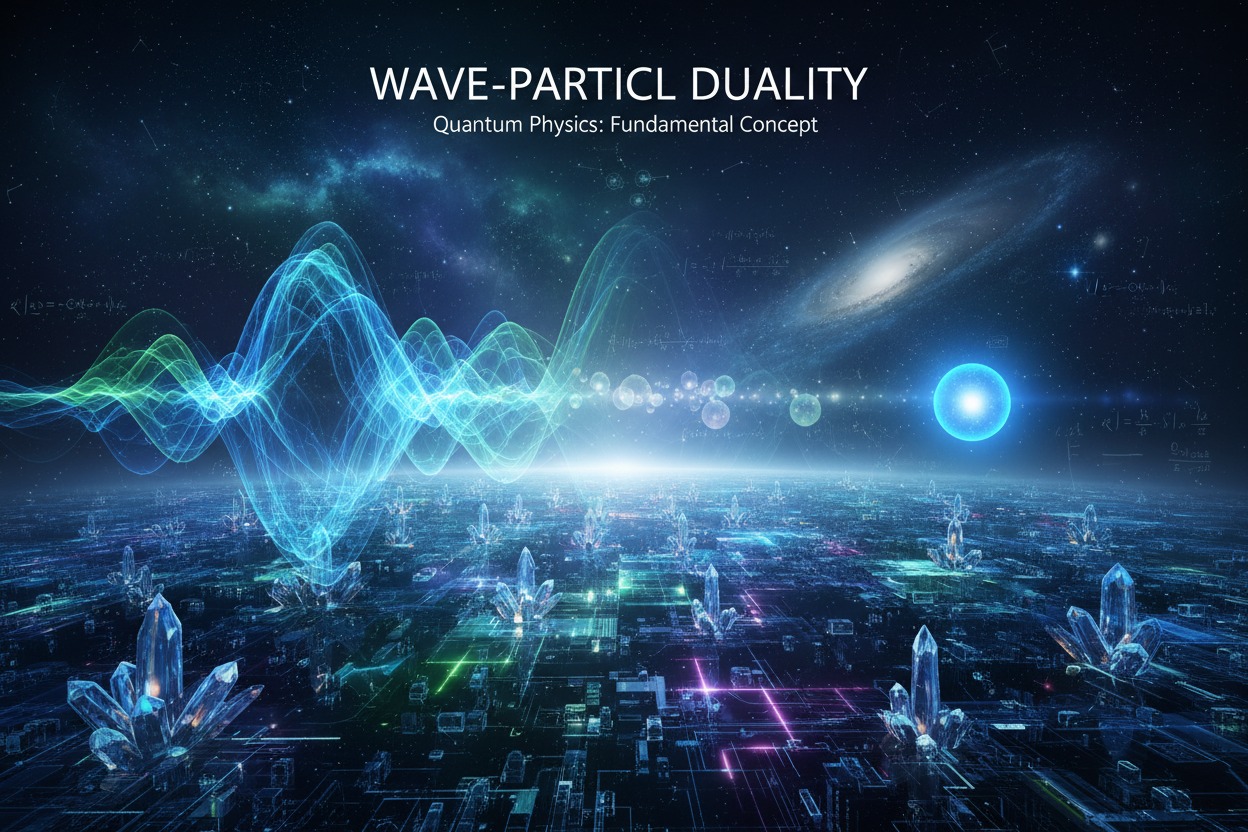
Moreover, quantum physics has paved the way for new research avenues in areas like quantum computing and quantum cryptography. Quantum computers, which leverage superposition and entanglement, promise to solve complex problems at unprecedented speeds compared to classical computers. Similarly, quantum cryptography offers unparalleled security in information transmission, making it an invaluable tool in our increasingly digital world.
The philosophical implications of quantum physics also warrant attention, as they prompt us to reconsider our understanding of reality itself. Concepts such as wave-particle duality and the uncertainty principle challenge the deterministic view held by classical physics. These ideas not only influence scientific inquiry but also resonate with broader philosophical discussions about the nature of existence and knowledge.
In conclusion, the importance of quantum physics in modern science cannot be overstated. It serves as a vital link between theoretical understanding and practical application, driving innovation across multiple fields. As research continues to unravel the mysteries of the quantum realm, we are likely to witness even more transformative effects on science and technology, shaping the future of our society in ways we are only beginning to comprehend.
Chapter 2: The Birth of Quantum Theory
Max Planck and Black-Body Radiation
Max Planck, a pivotal figure in the development of quantum theory, made significant contributions to our understanding of black-body radiation in the late 19th century. At that time, classical physics could not adequately explain the observed spectrum of radiation emitted by a black body, an idealised physical entity that absorbs all incident electromagnetic radiation. This discrepancy between theory and experiment led Planck to propose a revolutionary idea: that energy is quantised and can only be emitted or absorbed in discrete amounts, which he termed ‘quanta’.
In 1900, Planck introduced his groundbreaking formula for black-body radiation, which reconciled the predictions of classical physics with experimental observations. This formula, later known as Planck’s law, described how the intensity of radiation emitted by a black body varies with frequency at a given temperature. Planck’s law not only resolved the ultraviolet catastrophe, which classical physics could not, but also laid the groundwork for quantum mechanics, fundamentally changing the way we understand energy and matter.
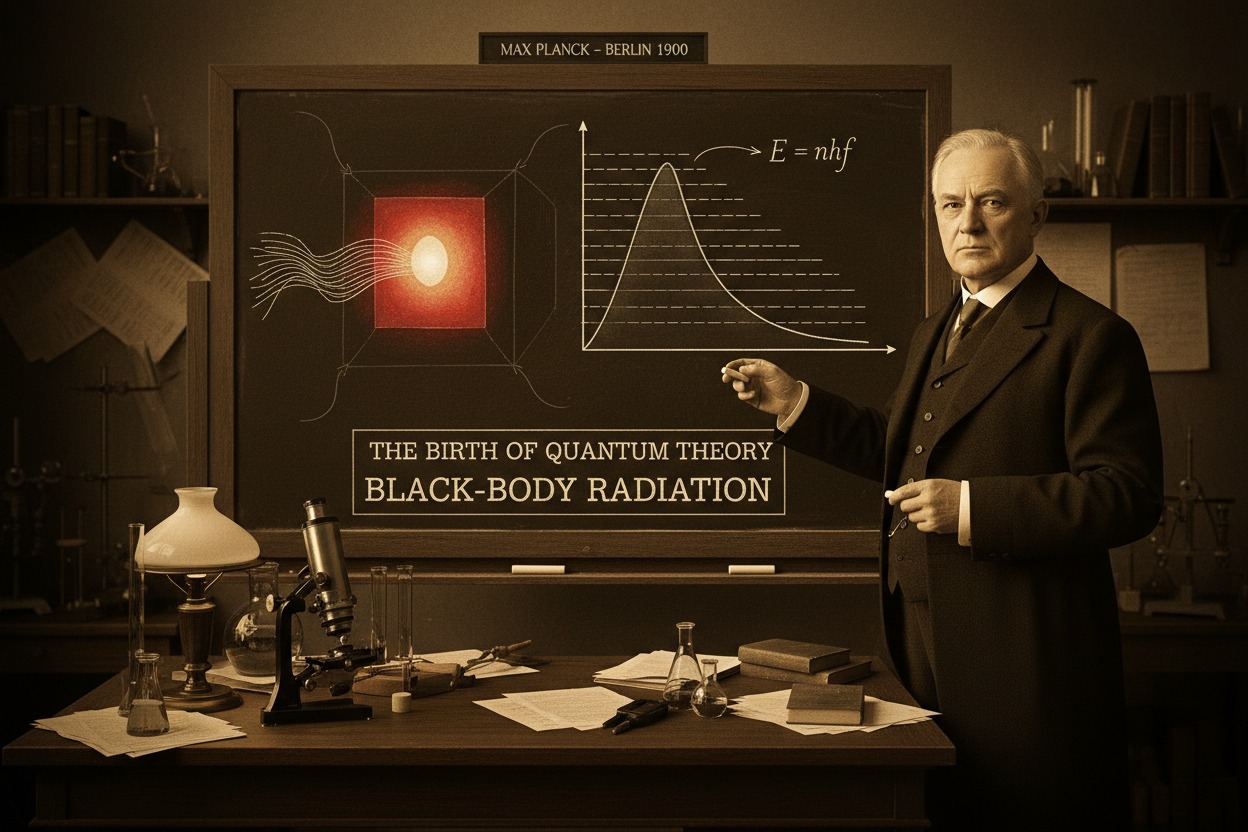
The introduction of quantisation was a radical departure from classical physics, which assumed that energy could take any value. Planck’s hypothesis suggested that energy levels are discrete, leading to the concept of quantised oscillators in a black body. This was a critical step towards the formulation of quantum theory, influencing later physicists like Albert Einstein and Niels Bohr, who expanded upon Planck’s ideas to further explore the quantum realm.
Planck’s work on black-body radiation did not only transform theoretical physics; it had practical implications as well. His theories contributed to advancements in various fields, including thermodynamics, quantum mechanics, and even modern technologies such as lasers and semiconductors. Understanding black-body radiation is essential for fields like astrophysics, where the emission spectra of stars provide insight into their composition and temperature.
In recognition of his revolutionary contributions, Max Planck was awarded the Nobel Prize in Physics in 1918. His legacy endures in the fundamental principles of quantum theory, which continue to influence contemporary research. The exploration of black-body radiation not only marked the dawn of quantum mechanics but also demonstrated the profound relationship between energy, frequency, and temperature, shaping our understanding of the universe itself.
Albert Einstein and the Photoelectric Effect
Albert Einstein’s work on the photoelectric effect was a pivotal moment in the development of quantum physics. This phenomenon, where light incident upon a material causes the emission of electrons, challenged classical physics’ understanding of light as merely a wave. Einstein proposed that light could also behave as a particle, or photon, which was a revolutionary idea at the time. This duality of light set the stage for many modern theories in physics and changed the way scientists perceived the interaction between light and matter.
In 1905, Einstein published a paper that explained the photoelectric effect using the concept of quantised energy levels. He posited that each photon carries a discrete amount of energy proportional to its frequency. This idea provided a clear explanation for why certain materials emitted electrons only when exposed to light above a specific frequency, a phenomenon that could not be explained by the wave theory of light alone. Einstein’s insights not only resolved existing puzzles but also laid the groundwork for future research into quantum mechanics.
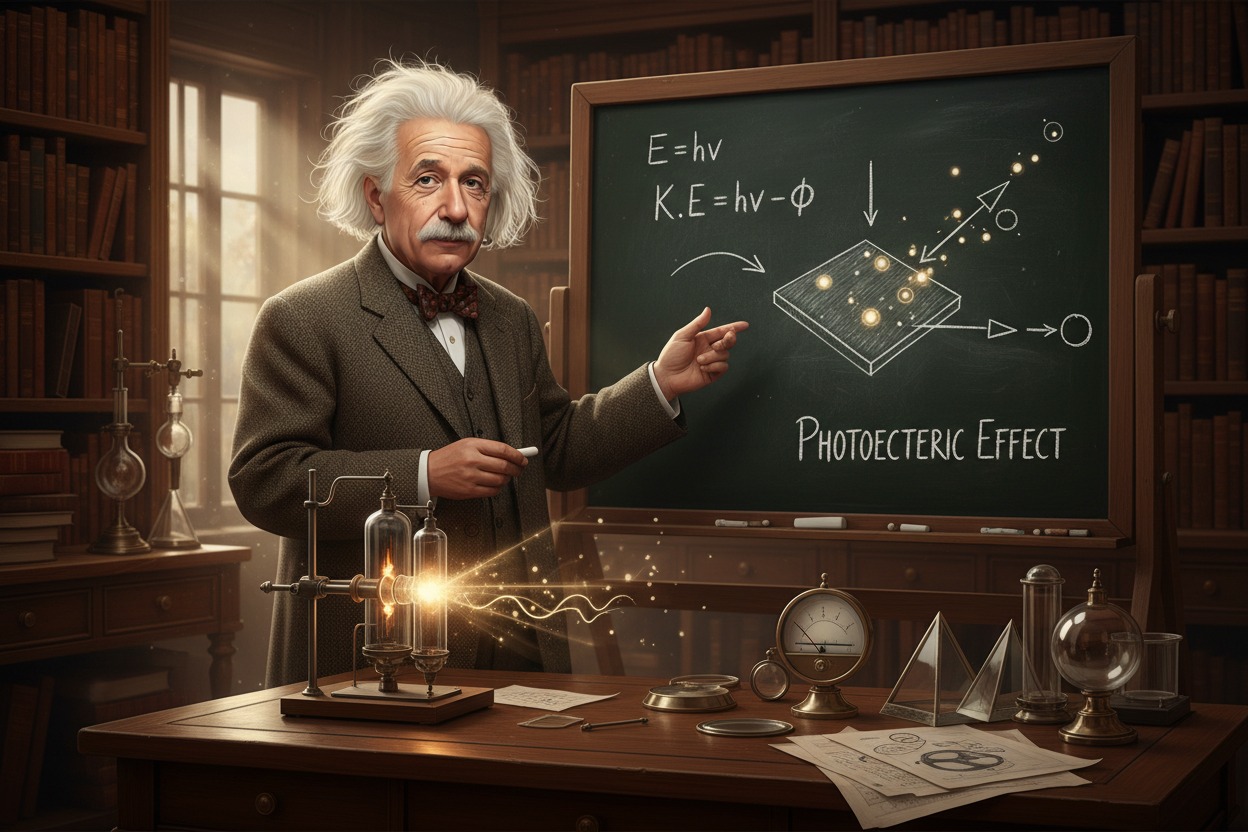
The implications of the photoelectric effect extended beyond theoretical physics. In 1919, Einstein was awarded the Nobel Prize in Physics, largely due to this work. His findings had significant consequences for the development of technologies such as solar cells and photodetectors, which rely on the principles of the photoelectric effect. These applications demonstrate how theoretical advancements can lead to practical innovations, bridging the gap between abstract science and everyday technology.
Moreover, the photoelectric effect has played a crucial role in experimental physics, providing a method for measuring the energy of photons and the work function of different materials. Numerous experiments have been conducted to explore this phenomenon, confirming Einstein’s predictions and contributing to the broader field of quantum mechanics. The accuracy and reliability of these experiments underscore the significance of the photoelectric effect in our understanding of the quantum world.
In conclusion, Albert Einstein’s exploration of the photoelectric effect not only transformed the landscape of physics but also reshaped our comprehension of light and energy. His work exemplifies the interplay between theory and experiment in science, illustrating how groundbreaking ideas can emerge from the desire to understand the fundamental nature of reality. The legacy of the photoelectric effect is evident in both theoretical advancements and practical applications, solidifying its importance in the annals of physics history.
Niels Bohr and the Hydrogen Atom
Niels Bohr’s contributions to the understanding of the hydrogen atom represent a pivotal moment in the evolution of quantum mechanics. In the early 20th century, the classical models of atomic structure failed to explain the discrete spectral lines observed in hydrogen. Bohr proposed a revolutionary model in 1913, suggesting that electrons occupy specific quantised orbits around the nucleus, thereby introducing the concept of quantisation into atomic theory. This model not only explained the spectral lines but also laid the groundwork for future developments in quantum physics.
The essence of Bohr’s model lies in its postulation that electrons can only reside in certain allowed orbits with fixed energies. When an electron transitions between these orbits, it emits or absorbs energy in the form of photons, corresponding to the difference in energy between the two states. This quantised behaviour provided a theoretical framework that matched experimental observations remarkably well, particularly the Balmer series of spectral lines in hydrogen. Bohr’s work was among the first to combine classical concepts with emerging quantum ideas, forging a new path for atomic theory.
Moreover, Bohr’s model introduced the idea of angular momentum quantisation, where the angular momentum of an electron in its orbit is quantised in integral multiples of h/2π. This was a significant departure from classical physics, where angular momentum could take on any value. By applying this quantisation condition, Bohr was able to derive the formula for the wavelengths of the spectral lines of hydrogen, confirming the predictive power of his model. This marked a turning point in physics, as it demonstrated the necessity of quantum concepts in explaining atomic phenomena.

Despite its successes, Bohr’s model had limitations. It could not accurately predict the spectra of atoms with more than one electron, nor could it explain finer details such as the Zeeman effect. Nevertheless, Bohr’s work prompted further investigations into atomic structure, leading to the development of more sophisticated quantum mechanical models, such as the Schrödinger equation. These advancements built upon the foundation laid by Bohr, illustrating the dynamic evolution of ideas in the realm of quantum physics.
In conclusion, Niels Bohr’s contributions to our understanding of the hydrogen atom were instrumental in shaping modern physics. His introduction of quantised orbits and the concept of angular momentum quantisation provided critical insights into atomic behaviour, influencing generations of physicists. While his model was eventually superseded by more comprehensive theories, the impact of Bohr’s work continues to resonate in the field of quantum mechanics, reminding us of the intricate dance between theory and observation in the pursuit of knowledge.
Chapter 3: The Fundamental Principles of Quantum Mechanics
Wave-Particle Duality
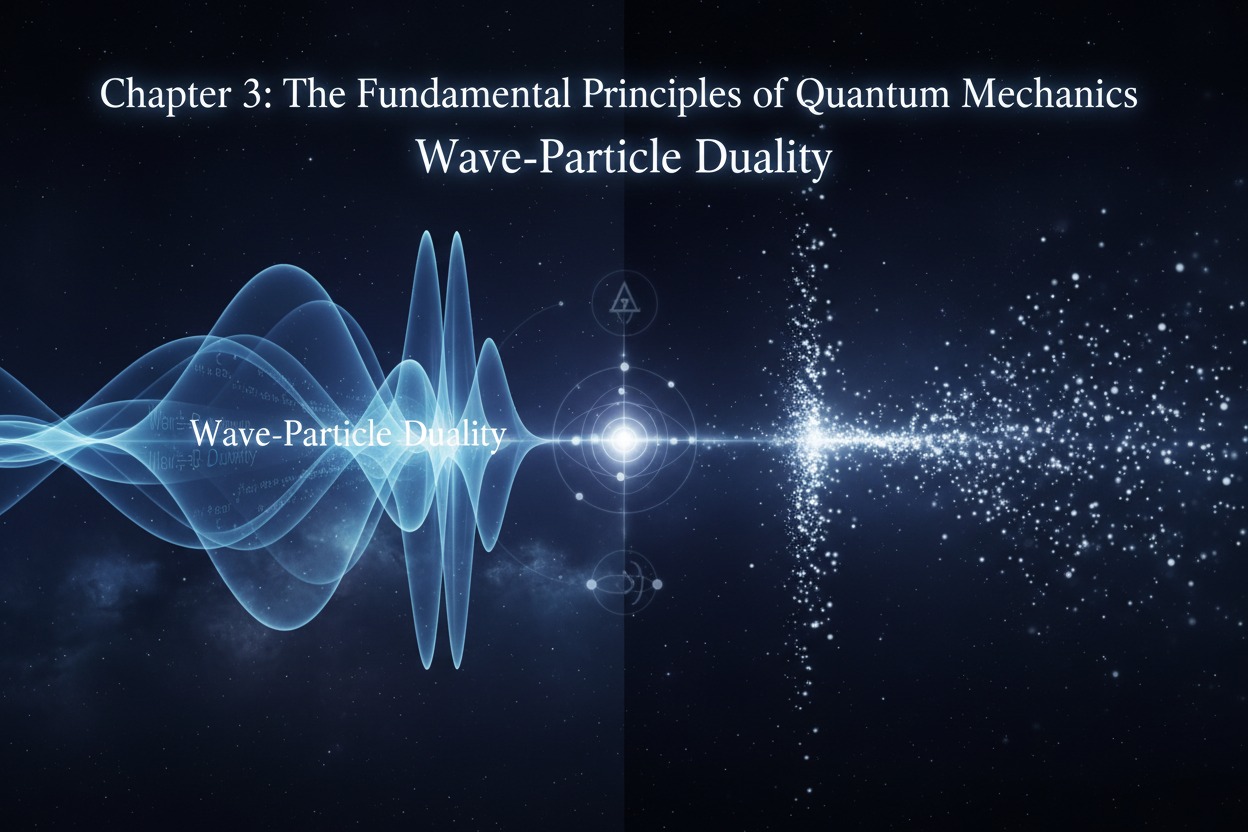
Wave-particle duality is one of the fundamental concepts of quantum mechanics, illustrating the dual nature of matter and light. This phenomenon asserts that particles, such as electrons and photons, exhibit both wave-like and particle-like properties depending on the context of their observation. The historical development of this theory began with the groundbreaking work of scientists like Albert Einstein and Louis de Broglie, who proposed that light can behave as both a wave and a particle, leading to a profound shift in our understanding of the physical world.
The double-slit experiment serves as a classic demonstration of wave-particle duality. In this experiment, particles such as electrons are fired at a barrier with two slits. When both slits are open, the particles create an interference pattern on a detection screen, characteristic of waves. However, when the experiment is altered to observe which slit the particle passes through, the interference pattern disappears, and the particles behave like classical particles. This striking result raises fundamental questions about the nature of observation and reality in quantum physics.
Further exploration of wave-particle duality leads us to the concept of superposition, where particles exist in multiple states simultaneously until measured. This principle is essential to understanding quantum entanglement and the non-locality phenomenon, where particles become interconnected in such a way that the state of one instantly influences the state of another, regardless of distance. Such insights challenge our classical notions of separateness and locality, compelling physicists to re-evaluate the very fabric of reality.
The implications of wave-particle duality extend beyond mere theoretical considerations. This duality has practical applications in technologies such as quantum computing and quantum cryptography, where the principles of superposition and entanglement are harnessed to perform calculations and secure communications in ways that classical systems cannot. As researchers continue to investigate these properties, they unveil potential pathways for revolutionary advancements in information technology and materials science.
In conclusion, wave-particle duality remains a cornerstone of modern physics, symbolising the complexity and richness of the quantum realm. As our understanding deepens, we are reminded that the universe operates on principles that often defy our intuitive perceptions, urging us to embrace the enigma of quantum realities. This duality not only enriches our scientific knowledge but also inspires philosophical inquiries into the nature of existence and our place within the cosmos.
The Uncertainty Principle
The Uncertainty Principle, a cornerstone of quantum mechanics, fundamentally alters our understanding of the behaviour of particles at a subatomic level. Formulated by Werner Heisenberg in 1927, it posits that certain pairs of physical properties, like position and momentum, cannot be simultaneously measured with arbitrary precision. This principle challenges classical physics, where it was assumed that objects possess definite attributes that can be measured independently of the observer. The implications of this principle extend far beyond theoretical physics, prompting philosophical debates about the nature of reality itself.
At the heart of the Uncertainty Principle lies the concept of wave-particle duality, which suggests that particles like electrons exhibit both wave-like and particle-like properties. This duality complicates our attempts to ascertain the exact state of a particle. For instance, the more precisely we measure a particle’s position, the less precisely we can know its momentum, and vice versa. This intrinsic limitation is not due to imperfections in measurement tools but is a fundamental characteristic of nature, indicating a limit to what can be known about a system.
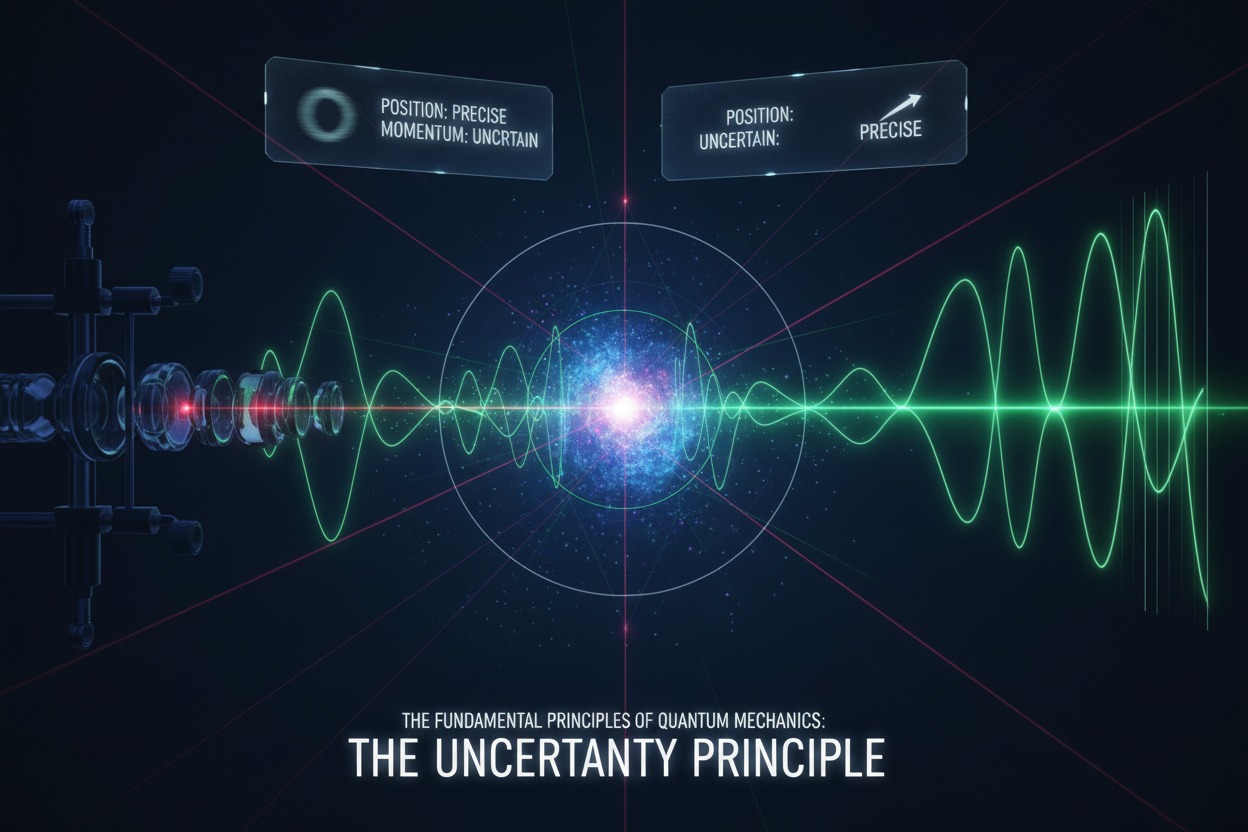
The Uncertainty Principle has profound effects on the behaviour of quantum systems, leading to phenomena such as quantum tunnelling and the creation of virtual particles. Quantum tunnelling allows particles to pass through energy barriers that they would not be able to surmount according to classical physics. This principle is essential in explaining processes like nuclear fusion in stars, where particles tunnel through potential barriers to collide and fuse, releasing vast amounts of energy. Such behaviours underscore the non-intuitive realities of the quantum world, where our classical intuitions often fail.
In practical terms, the Uncertainty Principle has led to the development of various technologies, including quantum computing and advanced imaging techniques. Quantum computers leverage the principles of superposition and entanglement, which are governed by the uncertainties inherent in quantum states, to perform computations far beyond the reach of classical machines. Similarly, techniques such as electron microscopy rely on the wave properties of electrons, allowing scientists to observe materials at unprecedented resolutions, revealing details that were previously obscured by classical limitations.
In conclusion, the Uncertainty Principle not only reshapes our understanding of measurement in quantum mechanics but also stimulates ongoing discussions about the nature of reality. As physicists continue to explore its implications, the principle remains a pivotal topic in both theoretical and applied physics. Understanding this fundamental aspect of quantum mechanics is crucial for anyone delving into the complexities of the physical universe, where certainty gives way to probabilities.
Quantum Superposition
Quantum superposition is a fundamental principle of quantum mechanics that describes how particles can exist in multiple states at once. This concept challenges classical intuitions about the nature of reality, where objects are typically perceived to occupy a single state or location at any given time. In quantum mechanics, however, a particle such as an electron can be in a superposition of various positions or energy levels, leading to complex and fascinating phenomena that defy conventional logic.
The famous thought experiment known as Schrödinger’s cat illustrates the concept of superposition vividly. In this scenario, a cat is placed in a sealed box with a radioactive atom and a poison vial. Until the box is opened and observed, the cat is said to be both dead and alive, existing in a superposition of states. This paradox not only highlights the peculiarities of quantum mechanics but also raises questions about the role of the observer in determining the state of a quantum system.
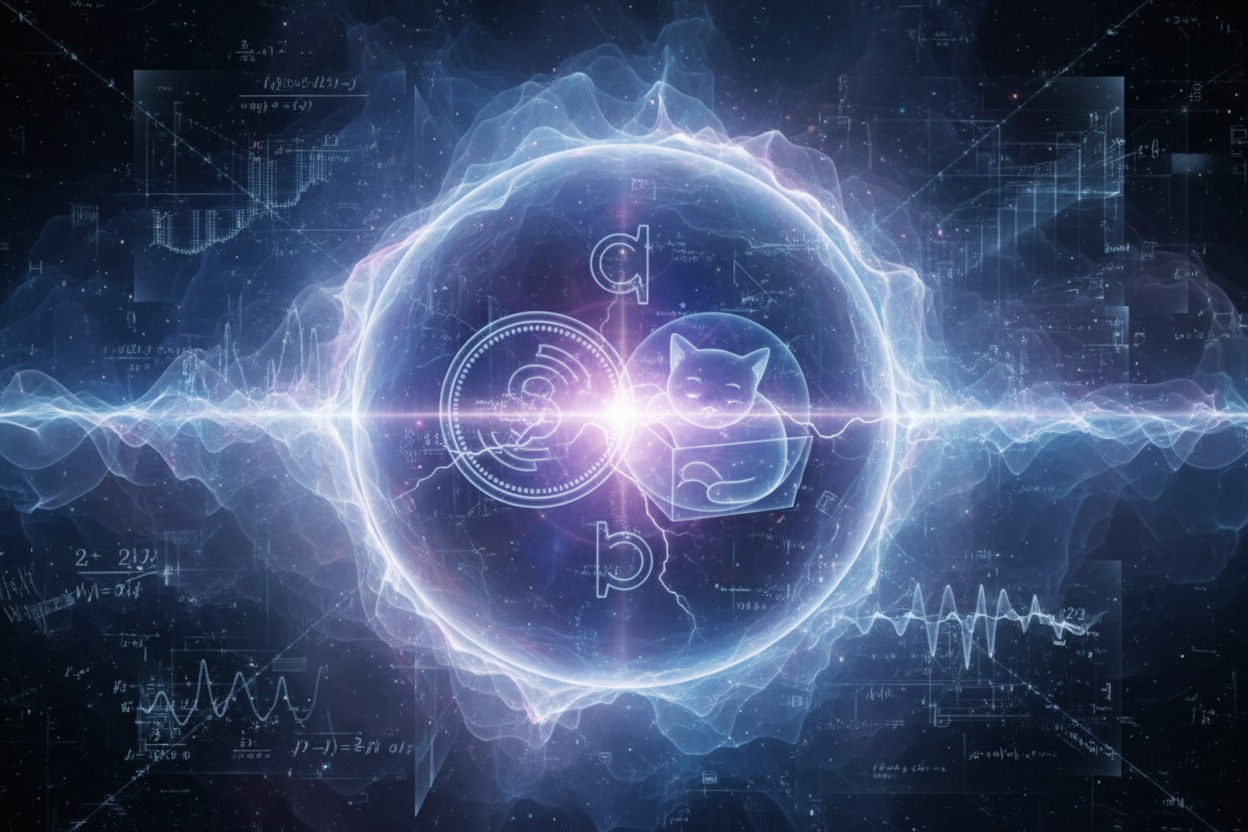
Superposition plays a crucial role in the operation of quantum computers, which harness the power of quantum bits, or qubits. Unlike classical bits that can be either a 0 or a 1, qubits can exist in a superposition of both states simultaneously. This capability allows quantum computers to perform complex calculations at unprecedented speeds, potentially revolutionising fields such as cryptography, optimisation, and artificial intelligence.
Moreover, superposition is not solely confined to individual particles; it extends to larger systems, including entangled particles that remain interconnected regardless of the distance separating them. This phenomenon has been experimentally demonstrated, revealing that measuring one particle affects the state of its entangled partner, even if they are light-years apart. Such results challenge our understanding of locality and the nature of information transfer in the quantum realm.
In conclusion, quantum superposition is a cornerstone of modern physics that invites both intrigue and debate. It opens doors to new technologies and insights into the fundamental workings of the universe. As researchers continue to explore the implications of superposition, the mysteries of quantum mechanics gradually unfold, offering a glimpse into a reality that transcends everyday experiences and perceptions.
Chapter 4: Quantum States and Measurement
Quantum States and Wave Functions
Quantum states represent the fundamental descriptions of a quantum system, encapsulating all the information necessary to predict the outcomes of measurements. These states can be expressed in various forms, the most prominent being the wave function, which provides a comprehensive mathematical representation of the quantum system’s behaviour. The wave function is a complex-valued function, generally denoted by the Greek letter psi (Ψ), and plays a crucial role in the formulation of quantum mechanics, allowing physicists to calculate probabilities associated with different measurements.
In quantum mechanics, the wave function embodies the principle of superposition, which states that a quantum system can exist in multiple states simultaneously until measured. This phenomenon leads to the counterintuitive nature of quantum mechanics, where particles can exhibit both wave-like and particle-like behaviours. The act of measurement causes the wave function to collapse, resulting in a definitive outcome from a range of possibilities. This intrinsic unpredictability distinguishes quantum mechanics from classical physics, where systems are deterministically predictable.
The interpretation of wave functions has been a topic of significant debate within the physics community. Various interpretations, such as the Copenhagen interpretation and Many-Worlds interpretation, offer different perspectives on the implications of the wave function and the nature of reality itself. These interpretations address questions about the role of the observer, the nature of measurement, and the existence of parallel universes, reflecting the profound philosophical implications of quantum mechanics.
Wave functions are not merely abstract concepts; they have practical applications in quantum technologies. For instance, advancements in quantum computing and quantum cryptography rely on the manipulation and understanding of quantum states. By harnessing the unique properties of wave functions, scientists can develop algorithms that outperform classical counterparts and create secure communication systems that leverage the principles of quantum entanglement.
In conclusion, quantum states and wave functions are pivotal concepts in modern physics that challenge our understanding of reality. They encapsulate the dual nature of particles, the complexities of measurement, and the broader implications of quantum mechanics on technology and philosophy. As research progresses, the exploration of these concepts will continue to unravel new dimensions of the quantum world, inviting both scientific inquiry and philosophical reflection.
The Role of Observation in Quantum Mechanics
Observation plays a crucial role in the realm of quantum mechanics, fundamentally challenging our understanding of reality. At its core, quantum mechanics posits that particles exist in states of probability until they are observed. This idea suggests that the act of measurement itself can influence the state of a quantum system, leading to the famous assertion that ‘observation affects reality.’ This paradoxical nature of quantum observation has prompted deep philosophical questions about the nature of existence and our role in the universe.
One of the most striking illustrations of this principle is the double-slit experiment. When particles such as electrons are fired at a barrier with two slits, they create an interference pattern that indicates wave-like behaviour. However, when an observation is made to determine which slit the particle passes through, the interference pattern disappears, and the particles behave like classical particles instead. This experiment powerfully demonstrates the impact of observation on quantum systems, revealing that the very act of measuring alters the outcome of the experiment.
The implications of these findings extend beyond mere experiments; they challenge the classical idea of an objective reality. In quantum mechanics, reality appears to be intertwined with the observer. Some interpretations suggest that consciousness may play a critical role in determining the state of a quantum system, leading to a re-evaluation of the nature of knowledge and existence itself. Thus, observation in quantum mechanics is not merely a passive activity but an active participant in shaping reality.
Furthermore, this notion has significant consequences for the interpretation of quantum mechanics. Various interpretations, such as the Copenhagen interpretation and many-worlds interpretation, attempt to explain the relationship between observation and reality. Each provides a unique perspective on how observation influences quantum phenomena, highlighting the necessity of a more nuanced understanding of the observer’s role in the quantum world. This ongoing debate illustrates the complexity and richness of quantum mechanics as a field of study.
In conclusion, the role of observation in quantum mechanics serves as a gateway to deeper philosophical inquiries about the nature of reality. As physicists continue to explore this complex relationship, the implications of their findings will undoubtedly shape our understanding of the universe. The intersection of observation and quantum mechanics not only challenges our scientific paradigms but also invites us to consider the profound questions about existence, perception, and the universe itself.
Collapse of the Wave Function
The collapse of the wave function is a pivotal concept in quantum mechanics that addresses the transition from the quantum superposition of states to a single observable outcome. This phenomenon occurs when a measurement is made, forcing the wave function, which encapsulates all possible states of a quantum system, to reduce to one of its eigenstates. The implications of this collapse are profound, challenging our classical intuitions about reality and measurement. In essence, it suggests that until an observation is made, particles exist in a state of probability, only adopting a definite state upon measurement.
This concept is intricately linked to the observer effect, where the act of measurement impacts the state of the system being observed. The famous double-slit experiment exemplifies this principle, demonstrating how particles such as electrons behave as waves when unobserved, creating an interference pattern. However, once a measurement is introduced, this wave-like behaviour collapses, resulting in particles behaving as discrete entities. This duality not only underscores the peculiar nature of quantum systems but also raises questions about the role of the observer in defining reality.
Philosophically, the collapse of the wave function has sparked intense debate regarding determinism and free will in the quantum realm. If outcomes are probabilistic and contingent upon observation, what does that imply for our understanding of causality? Some interpretations, like the Copenhagen interpretation, assert that reality is fundamentally probabilistic, while others, such as the many-worlds interpretation, propose that all possible outcomes exist simultaneously in parallel universes. This divergence illustrates the ongoing struggle to interpret the fundamental nature of reality as described by quantum mechanics.
In practical terms, the collapse of the wave function has critical implications for quantum technologies, particularly in quantum computing and cryptography. These fields rely on the principles of superposition and entanglement, where the collapse of the wave function must be controlled and understood to harness quantum states for computation or secure communication. As researchers delve deeper into the quantum realm, grasping the nuances of wave function collapse will be essential for advancing these technologies and realising their potential.
Ultimately, the study of the collapse of the wave function invites us to reconsider our perceptions of reality itself. As we delve deeper into the quantum world, we confront fundamental questions about existence, observation, and the nature of information. This exploration not only enhances our understanding of the universe but also challenges the very fabric of our philosophical and scientific paradigms, urging us to embrace the complexities and mysteries of quantum realities.
Chapter 5: Quantum Entanglement
The Concept of Entanglement
Entanglement is one of the most fascinating phenomena in quantum physics, showcasing the intricate connections between particles that exist irrespective of the distance separating them. When two particles become entangled, the state of one particle instantaneously influences the state of the other, even when they are light-years apart. This peculiar behaviour challenges our classical understanding of locality and causality, leading to profound implications for the nature of reality itself.
The concept of entanglement was famously illustrated by Einstein, Podolsky, and Rosen in their 1935 paper, which questioned whether quantum mechanics could be considered a complete theory. They posited that if quantum mechanics was indeed complete, then entangled particles would exhibit what Einstein referred to as “spooky action at a distance.” This term encapsulates the bewildering nature of entanglement and has spurred extensive debates among physicists regarding the interpretation of quantum mechanics.
In practical terms, entanglement has paved the way for groundbreaking advancements in quantum computing and quantum cryptography. Quantum computers harness entangled states to perform calculations at speeds unimaginable with classical computers. Meanwhile, quantum cryptography utilises entanglement to create secure communication channels, as any attempt to eavesdrop would disrupt the entangled state, alerting the parties involved.
Current research continues to explore the boundaries of entanglement, with experiments designed to test the limits of this phenomenon. Researchers are investigating the potential for entangling larger and more complex systems, moving beyond simple particles. These efforts not only deepen our understanding of quantum mechanics but also challenge our perceptions of the interconnectedness of the universe.
Ultimately, the concept of entanglement serves as a gateway to understanding the enigmatic nature of the quantum realm. As scientists unravel the mysteries surrounding this phenomenon, they may uncover new principles that could redefine our understanding of space, time, and the fundamental structure of reality. The implications of entanglement extend far beyond theoretical physics, touching upon philosophy and the very fabric of existence itself.
Experimental Evidence of Entanglement
The concept of entanglement lies at the heart of quantum mechanics, challenging our classical intuitions about the separability of physical systems. Experimental evidence has gradually unfolded, demonstrating that particles can become entangled, leading to correlations that cannot be explained by classical physics. One of the first significant experiments demonstrating entanglement was conducted by Alain Aspect in the early 1980s, where pairs of photons were produced and measured. The results showed that the measurements on one photon could instantaneously affect the results of the other, regardless of the distance separating them, a phenomenon that Einstein famously referred to as “spooky action at a distance.”
Following Aspect’s pioneering work, numerous experiments have reinforced the existence of entanglement, employing various particles such as electrons and atoms. These experiments typically involve creating entangled pairs and then measuring their states in different orientations. The correlations observed consistently violate Bell’s inequalities, which serve as a test of local realism. This evidence supports the non-local nature of quantum mechanics, suggesting that entangled particles share a connection that transcends classical boundaries.
More recent advancements in technology have allowed researchers to refine these experiments further, utilising sophisticated techniques such as quantum tomography. This method enables scientists to reconstruct the quantum state of entangled systems with greater precision. For instance, experiments using quantum dots and superconducting circuits have provided insights into the dynamics of entanglement and its potential applications in quantum computing and cryptography. As a result, experimental evidence of entanglement is not only foundational for understanding quantum theory but also pivotal for the development of new technologies.
The implications of entanglement extend beyond theoretical physics, influencing various fields including information technology and philosophy. Quantum entanglement has sparked debates about the nature of reality, causality, and the interconnectedness of the universe. It raises profound questions about the role of the observer and the fundamental nature of measurement in quantum mechanics. This intersection of physics and philosophy illustrates how entanglement challenges our understanding of the world, inviting deeper exploration into the fundamental principles governing the universe.
In conclusion, the experimental evidence of entanglement underscores the remarkable features of quantum mechanics that defy classical explanations. As researchers continue to explore this phenomenon, the understanding of entanglement will likely evolve, leading to new discoveries and applications. The ongoing investigation into entangled states not only enriches our comprehension of quantum reality but also propels advancements in technology that could transform our future. The journey into the realm of entanglement remains a vibrant area of study, promising to unravel even more mysteries as science progresses.
Implications for Information Transfer
The implications for information transfer within the realm of quantum mechanics are profound and complex. Quantum entanglement, a phenomenon where particles become interconnected regardless of distance, suggests that information can be transmitted instantaneously. This challenges classical notions of communication, introducing a new paradigm where the speed of information transfer is no longer limited by conventional means. As researchers explore these concepts, they are uncovering potential applications that may revolutionise how we understand information flow in the universe.
One significant implication of quantum information transfer is its potential impact on computing technology. Quantum computers, utilising the principles of superposition and entanglement, can process vast amounts of data simultaneously, outperforming classical computers in certain tasks. This could lead to breakthroughs in fields such as cryptography, where secure communication relies on the fundamental unpredictability of quantum states. The ability to transfer information through quantum channels may also enhance the security of data transmission, making it nearly impossible for eavesdroppers to intercept messages without detection.
Moreover, the exploration of quantum information transfer raises philosophical questions about the nature of reality and observation. If information can be transmitted instantaneously, what does this mean for our understanding of causality and the flow of time? The implications extend beyond physics into the realms of metaphysics and epistemology, challenging our perceptions of knowledge and existence. This intersection of disciplines invites a re-evaluation of long-held beliefs about the universe and our place within it.
As research progresses, the implications for information transfer in quantum mechanics could lead to practical applications in telecommunications and networking. Quantum key distribution, for instance, leverages the principles of quantum mechanics to create secure communication channels that are theoretically invulnerable to hacking. Such advancements could transform industries reliant on secure data transfer, providing robust solutions to contemporary challenges in cybersecurity.
In conclusion, the implications for information transfer in quantum realities are vast and transformative. As physicists delve deeper into the intricacies of quantum mechanics, they uncover not only technological advancements but also fundamental shifts in our understanding of information and reality itself. The future may hold unprecedented possibilities, as we harness the power of quantum phenomena to redefine communication and information exchange in the modern world.
Chapter 6: Quantum Field Theory
Introduction to Quantum Fields
Quantum fields represent one of the most profound concepts in modern physics, serving as the foundation for understanding the fundamental interactions of particles. At its core, the idea of a quantum field suggests that all particles are excitations or disturbances in their respective fields, which permeate all of space and time. This revolutionary perspective shifts the traditional view of particles as distinct entities, highlighting instead their intrinsic connection to the underlying fields that govern their behaviour.
In quantum field theory, each type of particle corresponds to a specific quantum field. For instance, electrons are excitations of the electron field, while photons arise from the electromagnetic field. This framework allows physicists to make sense of complex interactions, such as those that occur during particle collisions in accelerators. By viewing particles through the lens of fields, scientists can apply the principles of quantum mechanics to a broader range of phenomena, bridging the gap between particle physics and cosmology.
The mathematical formulation of quantum fields involves sophisticated techniques, including the use of operators and state vectors. These tools enable physicists to calculate probabilities and predict outcomes in a way that aligns with experimental results. One of the most significant achievements of quantum field theory is the unification of the electromagnetic force and the weak nuclear force into a single framework, known as electroweak theory, which has been confirmed through extensive experimental validation.
Moreover, the concept of quantum fields extends beyond the realm of particle physics to encompass the very fabric of spacetime itself. The idea that spacetime can be influenced by quantum fields leads to intriguing implications for our understanding of gravity and the universe’s structure. This intersection of quantum mechanics and general relativity remains a frontier in modern physics, with researchers striving to develop a coherent theory that integrates these two foundational pillars.
As we delve deeper into the intricacies of quantum fields, we begin to appreciate the elegance and complexity of the universe. The exploration of these fields not only enhances our comprehension of fundamental forces but also opens up new avenues for technological advancements, such as quantum computing and quantum communication. Understanding quantum fields is essential for any aspiring physicist, as they encapsulate the essence of the quantum world and its profound implications for our reality.
The Standard Model of Particle Physics
The Standard Model of Particle Physics is a comprehensive framework that describes the fundamental particles and forces that govern the universe. It unifies various aspects of particle physics into a coherent theory, detailing how elementary particles interact through three of the four known fundamental forces: electromagnetic, weak, and strong interactions. This model has been validated through numerous experiments, making it one of the most successful theories in scientific history.
Symmetry and Conservation Laws
Symmetry and conservation laws are fundamental concepts in modern physics that reveal the underlying order in the universe. Symmetry refers to the invariance of a system under certain transformations, such as rotations, translations, or reflections. In physics, these symmetries play a crucial role in determining the conservation laws that govern physical systems. For example, the symmetry of space leads to the conservation of momentum, while the symmetry of time results in the conservation of energy.
One of the most significant contributions of symmetry to physics is Noether’s theorem, which connects symmetries and conservation laws. Formulated by mathematician Emmy Noether in the early 20th century, this theorem states that every differentiable symmetry of the action of a physical system corresponds to a conservation law. This profound insight has far-reaching implications across various branches of physics, including classical mechanics, quantum mechanics, and field theory.
In quantum field theory, symmetry principles dictate the interactions of particles and fields. For instance, gauge symmetries are essential in the formulation of the standard model of particle physics, which describes the electromagnetic, weak, and strong forces. These symmetries ensure that the fundamental forces are consistent across different energy scales and provide a framework for understanding particle interactions. The discovery of the Higgs boson, a particle associated with the Higgs field, exemplifies how symmetry breaking leads to mass generation for other particles.
Moreover, symmetries extend beyond particle physics into cosmology, where they play a vital role in the evolution of the universe. The uniformity of the cosmic microwave background radiation suggests a high degree of symmetry in the early universe. As the universe expanded, these symmetries were broken, leading to the formation of structures such as galaxies and clusters. Understanding these symmetries and their violations helps physicists unravel the mysteries of dark matter and dark energy, which remain some of the most perplexing elements in modern cosmology.
In conclusion, the interplay between symmetry and conservation laws is a cornerstone of our understanding of the physical world. These principles not only provide a framework for describing the behaviour of systems but also guide experimental investigations in search of new physics. As research progresses, ongoing explorations into the symmetries of nature may yield even deeper insights into the fundamental workings of the universe, ultimately enriching our comprehension of reality itself.
Chapter 7: Quantum Computing
Overview of Quantum Computing Principles
Quantum computing represents a paradigm shift in computational capabilities, harnessing the principles of quantum mechanics to process information in fundamentally different ways compared to classical computing. At its core, quantum computing relies on quantum bits, or qubits, which can exist in multiple states simultaneously due to superposition. This allows quantum computers to perform many calculations at once, vastly increasing their computational power for specific tasks, such as cryptography and complex simulations.
Another essential principle of quantum computing is entanglement, a phenomenon where pairs or groups of qubits become interconnected in such a way that the state of one qubit can instantly affect the state of another, regardless of the distance between them. This unique property enables faster information transfer and enhances the efficiency of quantum algorithms. By leveraging entangled qubits, quantum computers can solve problems that are currently intractable for classical systems.
Quantum gates, analogous to classical logic gates, manipulate qubits through precise operations that exploit quantum mechanical phenomena. These gates form the building blocks of quantum circuits, allowing for the implementation of algorithms such as Shor’s algorithm for factoring large numbers and Grover’s algorithm for database searching. The design and optimisation of quantum circuits remain critical research areas, as they directly influence the performance and reliability of quantum computations.
Moreover, quantum decoherence poses a significant challenge to the development of practical quantum computers. Decoherence occurs when qubits lose their quantum state due to interaction with the environment, leading to errors in computation. Researchers are actively exploring various error correction techniques and noise reduction strategies to mitigate the effects of decoherence, aiming to create stable and reliable quantum systems.
As quantum computing continues to evolve, its potential applications across various fields, including material science, drug discovery, and artificial intelligence, are becoming increasingly evident. Understanding the fundamental principles of quantum computing is essential for the next generation of physicists and computer scientists, as they prepare to unlock the vast potential of this revolutionary technology.
Qubits and Quantum Gates
Qubits are the fundamental building blocks of quantum computing, analogous to classical bits but with vastly different properties. Unlike a bit, which can be either 0 or 1, a qubit can exist simultaneously in a state of 0 and 1, thanks to the principle of superposition. This unique characteristic allows quantum computers to process a vast amount of information simultaneously, providing an exponential increase in computational power for certain types of problems.
Quantum gates are the operational elements that manipulate qubits, similar to how classical logic gates operate on bits. These gates perform various operations, such as flipping the state of a qubit or entangling multiple qubits together. The function of these gates is fundamentally probabilistic, meaning their effects can only be predicted in terms of probabilities, which is a cornerstone of quantum mechanics. Each quantum gate corresponds to a specific unitary transformation, allowing for the precise control of qubit states.
One of the most significant types of quantum gates is the Hadamard gate, which creates superposition by transforming a qubit from a definite state to a state of equal probability for 0 and 1. Another essential gate is the CNOT (controlled-NOT) gate, which entangles qubits by flipping the state of a target qubit based on the state of a control qubit. These gates serve as the foundation for quantum algorithms, enabling complex computations that are infeasible for classical computers.
The combination of qubits and quantum gates has led to the development of quantum circuits, which are sequences of quantum gates applied to a set of qubits. Quantum circuits allow for the execution of algorithms that harness the power of quantum superposition and entanglement. As researchers continue to explore the potential of quantum circuits, they aim to create more efficient algorithms that could revolutionise fields such as cryptography, materials science, and artificial intelligence.
In summary, the interplay between qubits and quantum gates is central to the field of quantum computing. This synergy not only enhances computational capabilities but also challenges our understanding of information processing in the quantum realm. As this technology matures, it promises to unlock new avenues of research and applications, positioning quantum computing at the forefront of modern physics.
Applications of Quantum Computing
Quantum computing is poised to revolutionise various sectors by enabling computations that were previously deemed impossible. One primary application is in cryptography, where quantum algorithms can break traditional encryption methods, thus necessitating the development of quantum-resistant cryptographic systems. This potential shift could alter the landscape of data security, making it imperative for industries to adapt and innovate in response to these advancements.
Another significant application lies in optimisation problems, which are prevalent in logistics, finance, and manufacturing. Quantum computers can process vast amounts of data simultaneously, allowing for more efficient solutions to complex optimisation challenges. This capability can lead to substantial cost reductions and improved operational efficiencies in various industries, showcasing the practical benefits of embracing quantum technology.
In the field of medicine, quantum computing shows promise in drug discovery and personalised medicine. By simulating molecular interactions at an unprecedented scale, quantum computers can accelerate the identification of potential drug candidates and tailor treatments to individual patients based on their unique genetic make-up. This application not only holds the potential to enhance patient outcomes but also to significantly reduce the time and cost associated with bringing new drugs to market.
Additionally, quantum computing can impact artificial intelligence (AI) and machine learning. The enhanced computational power allows for more sophisticated algorithms that can learn from data more effectively. This can lead to breakthroughs in AI applications, such as natural language processing and image recognition, ultimately resulting in more intelligent systems that can operate autonomously and make decisions in real-time.
Finally, quantum simulations offer insights into complex physical systems that are challenging to model with classical computers. This capability can facilitate advancements in material science, allowing researchers to design new materials with desirable properties for use in various applications, from electronics to renewable energy. The ability to accurately simulate quantum phenomena opens new frontiers in research and technology development, reaffirming the transformative potential of quantum computing.
Chapter 8: Quantum Technologies
Quantum Cryptography
Quantum cryptography represents a groundbreaking intersection of quantum mechanics and information security, promising to redefine the way we protect sensitive data. At its core, this technology leverages the principles of quantum mechanics, particularly the behaviour of photons, to create a communication channel that is theoretically invulnerable to eavesdropping. Unlike classical cryptographic methods, which rely on mathematical complexity, quantum cryptography ensures security through the laws of physics. This unique approach leads to the formation of what is known as Quantum Key Distribution (QKD), a technique that allows two parties to share a secure key without the risk of interception.
Quantum Teleportation
Quantum teleportation is a fascinating phenomenon that bridges the gap between classical and quantum physics. At its core, it involves the transfer of quantum information from one location to another without the physical movement of the particle itself. This process relies heavily on the principles of quantum entanglement, where two particles become linked in such a way that the state of one instantly influences the state of the other, regardless of the distance separating them.
The process begins with two particles that are entangled. When a third particle is introduced, its quantum state is measured, which in turn collapses the state of the entangled pair. This measurement creates a scenario where the quantum state of the original particle can be reconstructed at the location of the second entangled particle. Thus, the information is effectively ‘teleported’ from one particle to another without any physical transfer of the particle itself.
One of the most significant implications of quantum teleportation is its potential application in quantum computing and communication. By enabling the transfer of quantum states, teleportation could revolutionise how information is processed and shared, leading to the development of ultra-secure communication channels. This could fundamentally change the landscape of information technology, making it faster and more secure than ever before.
However, despite its promising capabilities, quantum teleportation is not without its challenges. The process requires precise control and measurement of quantum states, which is currently a significant technical hurdle within the field. Researchers continue to explore ways to improve the efficiency and reliability of quantum teleportation, aiming to bring its theoretical applications closer to practical reality.
In conclusion, quantum teleportation exemplifies the extraordinary capabilities of quantum mechanics, showcasing how information can be transmitted in ways that defy our classical intuitions. As scientists delve deeper into this phenomenon, the potential for groundbreaking advancements in technology and communication remains vast, inviting further exploration and understanding of the quantum realm.
Quantum Sensors
Quantum sensors represent a groundbreaking advancement in the field of measurement, utilising the principles of quantum mechanics to achieve unprecedented sensitivity and accuracy. These devices exploit quantum phenomena such as superposition and entanglement to detect physical quantities with remarkable precision. This capability makes them indispensable in various applications, ranging from fundamental physics experiments to practical technologies in medical imaging and navigation systems.
One of the most notable examples of quantum sensors is the atomic interferometer, which uses the wave-like properties of atoms to measure gravitational fields and inertial forces. By employing cold atoms in a controlled environment, these sensors can detect minute changes in gravitational acceleration or rotation. This has significant implications for geophysics, as it allows scientists to monitor seismic activity and study the Earth’s interior structure with greater detail than traditional methods.
Another area where quantum sensors excel is in the field of magnetometry. Quantum sensors, such as those based on nitrogen-vacancy centres in diamonds, can measure magnetic fields at the nanoscale. This technology is particularly useful in medical applications, such as functional magnetic resonance imaging (fMRI), where it helps in mapping brain activity with high resolution. The ability to detect weak magnetic fields opens new avenues for research in neuroscience and materials science.
Moreover, the development of quantum-enhanced sensors is paving the way for advancements in telecommunications and information technology. Quantum key distribution, for instance, relies on quantum sensors to ensure secure communication channels. As the demand for secure data transmission grows, the role of quantum sensors in safeguarding information will become increasingly vital, highlighting their importance in modern society.
In conclusion, quantum sensors are at the forefront of a technological revolution, transforming our ability to measure and understand the physical world. Their unique properties and capabilities not only enhance existing measurement techniques but also open up new possibilities across various scientific disciplines and industries. As research continues, the full potential of quantum sensors will undoubtedly unfold, leading to innovations that could reshape our approach to numerous challenges in physics and beyond.
Chapter 9: Philosophical Implications of Quantum Mechanics
The Nature of Reality
The nature of reality has been a subject of profound inquiry in both philosophy and physics. In modern physics, particularly quantum mechanics, reality is not merely a straightforward reflection of the physical world we observe. Instead, it suggests that reality is deeply intertwined with the observer’s perception, leading to various interpretations that challenge our traditional understanding. This complexity introduces an intriguing dimension to the nature of existence itself, prompting scientists and philosophers alike to reconsider the fundamental principles that govern our universe.
At the heart of quantum mechanics lies the principle of superposition, which posits that particles can exist in multiple states simultaneously until they are observed. This phenomenon raises questions about the role of consciousness and observation in shaping reality. Is reality an objective truth that exists independently of us, or is it a subjective experience influenced by our observations? The implications of this principle extend beyond physics and delve into the realms of metaphysics and epistemology, where the definitions of truth and existence are rigorously examined.
Entanglement further complicates our understanding of reality, as it reveals the interconnectedness of particles across vast distances. When particles become entangled, the state of one instantly influences the state of another, regardless of the space separating them. This phenomenon suggests that the universe is not a collection of isolated entities but rather a cohesive whole. Such insights compel us to rethink the nature of causality and locality, challenging the classical notions that have dominated scientific thought for centuries.
The interpretations of quantum mechanics, including the Copenhagen interpretation and many-worlds hypothesis, illustrate the diverse perspectives on the nature of reality. Each interpretation offers a unique lens through which to understand quantum phenomena, reflecting the underlying philosophical debates about the essence of existence. As these ideas permeate both scientific and philosophical discourse, they encourage an interdisciplinary approach to exploring the nature of reality, bridging gaps between empirical science and theoretical inquiry.
Ultimately, the nature of reality as presented by quantum physics invites us to embrace uncertainty and complexity. It challenges the simplistic view of a deterministic universe, urging us to accept that our understanding of reality is always evolving. As we continue to uncover the mysteries of modern physics, we are reminded that reality is not just a static backdrop for our lives but a dynamic interplay of forces, perceptions, and possibilities that shape our very existence.
Determinism vs. Indeterminism
The debate between determinism and indeterminism lies at the heart of modern physics, particularly in the realm of quantum mechanics. Determinism posits that every event or state of affairs, including every human action, is the outcome of preceding events in accordance with the natural laws. This perspective suggests a universe governed by predictable patterns, where knowledge of initial conditions is sufficient to forecast future states with absolute certainty. Notably, classical physics often embraced this viewpoint, as exemplified by Newtonian mechanics, where physical systems operate under unchangeable laws.
In contrast, indeterminism introduces an element of randomness and unpredictability into the fabric of reality. Quantum mechanics, a cornerstone of contemporary physics, challenges the deterministic narrative by suggesting that certain phenomena cannot be predicted with certainty. The famous Heisenberg Uncertainty Principle exemplifies this, asserting that the more precisely one property of a particle is measured, the less precisely another can be controlled or known. This inherent unpredictability raises significant questions about the nature of reality and the limits of human knowledge.
The implications of these two philosophies extend beyond theoretical discussions; they influence our understanding of causality, free will, and even the nature of consciousness. If the universe is fundamentally indeterministic, it opens up avenues for free will, allowing for a more nuanced interpretation of human behaviour and decision-making. Conversely, a deterministic universe implies a more rigid framework, where everything, including human actions, is predetermined by prior states.
Recent advancements in quantum theory have led to a resurgence of interest in these concepts, prompting physicists to reconsider the philosophical underpinnings of their field. Experiments involving quantum entanglement and superposition have unveiled phenomena that appear to defy classical intuition, further blurring the lines between determinism and indeterminism. The ongoing exploration of these ideas challenges scientists to reconcile the mathematical elegance of quantum mechanics with the philosophical questions it raises.
Ultimately, the discourse surrounding determinism and indeterminism is not just an academic exercise; it reflects our quest to understand the universe and our place within it. As physicists delve deeper into the quantum realm, the implications of these contrasting views will continue to shape the future of scientific inquiry. Whether the universe is deterministic or indeterministic remains one of the most profound questions in modern physics, inviting ongoing exploration and debate among scholars and enthusiasts alike.
The Role of the Observer
In the realm of quantum mechanics, the observer plays a crucial role that fundamentally challenges our classical intuitions about reality. The act of observation is not merely passive; it actively influences the state of a quantum system. This concept, often illustrated by the famous double-slit experiment, reveals that particles behave differently when they are being observed, leading to profound implications for our understanding of measurement and reality itself.
The observer effect suggests that the mere act of measurement can determine the outcome of a quantum event. When a particle is not being observed, it exists in a superposition of states, displaying wave-like properties. However, once an observation is made, this superposition collapses into a definite state. This phenomenon raises questions about the nature of reality and the role of consciousness in the physical world, sparking debates among physicists and philosophers alike.
Furthermore, the role of the observer extends beyond the mere act of measurement. It challenges the notion of objective reality, suggesting that the universe may not exist in a defined state independent of observation. This perspective aligns with interpretations such as the Copenhagen interpretation, which posits that quantum systems only attain definite properties through the act of observation, thereby intertwining the observer with the fabric of reality.
Exploring the implications of the observer’s role also leads to discussions about entanglement and non-locality. These phenomena suggest that particles can be interconnected in ways that defy classical explanations, further complicating the relationship between observer and observed. This interdependence invites a reevaluation of the boundaries between the observer and the physical universe, encouraging a more holistic view of reality.
In conclusion, the role of the observer in quantum mechanics is not simply a technical detail but a fundamental aspect that reshapes our understanding of existence. As we continue to explore the mysteries of quantum realities, it becomes increasingly clear that the interplay between observation and reality is a profound frontier in modern physics. This exploration not only challenges our assumptions but also invites us to reconsider our place within the universe itself.
Chapter 10: Future Directions in Quantum Physics
Emerging Research Areas
In recent years, the field of quantum physics has seen a surge in emerging research areas that promise to reshape our understanding of the universe. One notable area is quantum computing, which seeks to leverage the principles of quantum mechanics to perform calculations at speeds unattainable by classical computers. Researchers are exploring various quantum algorithms, such as Shor’s algorithm for factoring large numbers, which has significant implications for cryptography and data security. This rapid advancement in computational capabilities could revolutionise multiple sectors, from pharmaceuticals to artificial intelligence.
Another promising area is quantum communication, which focuses on the secure transmission of information using quantum states. Techniques like quantum key distribution (QKD) enable two parties to share cryptographic keys with absolute security, as any attempt to eavesdrop would disturb the quantum state and alert the communicators. This area of research is vital for developing future-proof communication networks, particularly in an age where data privacy is paramount. The implications of successful quantum communication could lead to an entirely new framework for secure information exchange globally.
Quantum sensing is yet another emerging research area that exploits quantum phenomena to enhance measurement precision beyond classical limits. This includes advancements in gravitational wave detection and magnetic field sensing, which can have profound applications in medical imaging and navigation systems. The ability to detect minute changes in physical parameters could lead to breakthroughs in various scientific and industrial fields, providing tools that enhance our understanding of complex systems.
Additionally, the intersection of quantum physics with materials science is opening new avenues for research. Quantum materials, such as topological insulators and superconductors, exhibit unique properties that could lead to the development of novel electronic devices. Investigating these materials at the quantum level allows scientists to manipulate their characteristics for practical applications, potentially leading to advancements in energy efficiency and electronic performance.
Finally, the philosophical implications of quantum mechanics continue to be a fertile ground for research. Questions surrounding the nature of reality, measurement, and the role of the observer remain at the forefront of discussions among physicists and philosophers alike. Engaging with these philosophical dimensions is crucial, as it not only shapes theoretical frameworks but also influences how we interpret experimental results and their significance in our understanding of the universe.
Interdisciplinary Approaches
Interdisciplinary approaches to quantum physics are essential for broadening our understanding of the complex phenomena that define this field. By integrating concepts from mathematics, philosophy, and even art, researchers can develop innovative frameworks that challenge traditional paradigms. This synergy not only enhances theoretical development but also offers new perspectives on empirical data, leading to richer interpretations of quantum mechanics.
One of the key benefits of interdisciplinary collaboration is the ability to tackle problems from multiple angles. For instance, mathematicians contribute advanced computational techniques that can simulate quantum systems, while philosophers engage with the fundamental implications of quantum theory on our understanding of reality. Such collaborative efforts foster an environment where ideas can flourish, leading to breakthroughs that might not emerge within the confines of a single discipline.
Moreover, the intersection of quantum physics with fields like biology and cognitive science has sparked intriguing discussions about the nature of consciousness and its relationship to the physical universe. Researchers are exploring how quantum processes might influence biological systems, suggesting that the principles of quantum mechanics could underpin phenomena such as consciousness itself. This line of inquiry invites a profound re-evaluation of both scientific and philosophical perspectives on life and existence.
Art also plays a significant role in shaping our understanding of quantum realities. Artists inspired by quantum theories often create works that reflect the abstract and sometimes counterintuitive nature of the quantum world. These artistic interpretations serve as a bridge between complex scientific concepts and public understanding, making quantum physics more accessible to a broader audience and encouraging dialogue between scientists and the community.
In conclusion, embracing interdisciplinary approaches in quantum physics not only enriches the field but also promotes a holistic understanding of the universe. By fostering collaboration across diverse disciplines, we can address the profound questions posed by quantum mechanics and continue to unravel its mysteries. This comprehensive understanding is essential for not only advancing scientific knowledge but also for addressing the philosophical implications of our discoveries.
The Quest for a Unified Theory
The quest for a unified theory in modern physics represents one of the most ambitious endeavours in the scientific community. Physicists have long sought to reconcile the seemingly disparate realms of quantum mechanics and general relativity. These two pillars of physics describe the universe at its smallest scales and the grand cosmic structures, respectively, yet a cohesive framework that unites them remains elusive. Understanding this quest is pivotal for any student of physics, as it embodies the spirit of inquiry and the pursuit of knowledge that defines the discipline.
Historically, many theories have attempted to bridge the gap between quantum mechanics and general relativity. String theory, for instance, proposes that fundamental particles are not point-like but rather one-dimensional strings, which can vibrate at different frequencies. This theory attempts to incorporate gravity into the quantum framework, offering a tantalising glimpse of a more unified understanding of the universe. However, experimental validation has proven challenging, leading to debates about the validity and practicality of such theories.
Another significant approach is loop quantum gravity, which seeks to quantise space-time itself. Unlike string theory, it does not require additional dimensions or particles but instead focuses on the discrete nature of space-time at the Planck scale. This theory has gained traction for its ability to provide a coherent picture of black holes and the Big Bang, although it too faces hurdles regarding empirical support. The ongoing developments in these areas illustrate the dynamic nature of theoretical physics and the continual push towards a unified description of reality.
As researchers grapple with these complex theories, the implications of a unified theory extend beyond mere academic interest. Such a framework could revolutionise our understanding of the universe, potentially leading to new technologies and insights into the fundamental workings of nature. The quest for a unified theory is not just a scientific challenge; it embodies humanity’s innate desire to comprehend the cosmos and our place within it. This pursuit continues to inspire generations of physicists, driving forward the frontiers of knowledge.
In conclusion, the journey towards a unified theory remains one of the most profound challenges in physics today. With each advancement, we inch closer to a deeper understanding of the universe’s fabric. While the road ahead is fraught with difficulties and uncertainties, the relentless pursuit of a unified theory exemplifies the essence of scientific exploration. As we stand on the brink of new discoveries, the hope for a cohesive theory that elegantly ties together the fundamental forces of nature remains a guiding light for physicists around the world.
Leave a Reply