
SEO meta description
Could data centres really be built in space? Explore orbital computing, AI, solar power, cooling, satellites, launch costs and space debris.
Focus keyword
data centres in space
Secondary keywords
- orbital data centres
- space data centres
- data centres in orbit
- orbital computing
- AI in space
- space computing
- satellite computing
- artificial intelligence in space
- solar power in space
- future data centres
- space technology
- satellite networks
- Starlink
- space debris
- future of AI
Tags
Data Centres in Space, Orbital Data Centres, Space Computing, AI in Space, Artificial Intelligence, Orbital Computing, Satellite Technology, Space Technology, Solar Power, Starlink, Space Debris, Cloud Computing, Future Technology, Data Centres, Science, Space Exploration
Category hierarchy
Science & Technology
└── Space Technology
└── Orbital Computing
If you want to keep the WordPress category structure simpler, I would use:
Science & Technology
└── Space
Suggested URL slug
could-data-centres-be-built-in-space
Could the computers of the future live above our heads? Explore how solar power, AI, satellites and orbital computing could create a new generation of data centres in space.
Could Data Centres Really Be Built in Space?
Could the computers of the future live above our heads?
Solar power, artificial intelligence, satellites and the race to build the next generation of computing infrastructure.

Featured image: Earth viewed from space — Unsplash.
Image source: https://unsplash.com/photos/a-view-of-the-earth-from-space-mUYmAF9mHow
A New Idea Is Moving From Science Fiction Towards Serious Engineering
For decades, the idea of putting computers in space belonged largely to science fiction. Today, however, orbital computing is being investigated as a potential part of the future digital infrastructure.
A new policy paper published on 28 September 2026 examines the possibilities and limitations of orbital data centres. The Information Technology and Innovation Foundation says orbital data centres could potentially complement terrestrial infrastructure by processing selected workloads in space rather than attempting to replace conventional data centres on Earth.
That distinction is important. A giant cloud data centre is relatively easy to reach, upgrade, repair and expand. A computer in orbit is none of those things.
“Orbital data centers are more likely to complement—not replace—terrestrial data centers.”
The quotation above is from the Information Technology and Innovation Foundation’s policy paper published on 28 September 2026.
Why Put Computers in Space?
The argument begins with a simple problem: modern computing, particularly artificial intelligence, requires enormous quantities of electricity, hardware, networking capacity and cooling.
Instead of building every future data centre on land, engineers are investigating whether some computing could operate on satellites powered by the Sun.
The concept could be particularly interesting when the data is already being generated in space.
- Earth-observation satellites could process images before sending them to Earth.
- Remote-sensing spacecraft could analyse information in orbit.
- Spacecraft could make decisions without waiting for instructions from Earth.
- AI systems could process satellite data closer to where it is collected.
- Future lunar and deep-space missions could use local computing rather than constantly transmitting raw information home.
The ITIF report identifies Earth observation, remote sensing and spacecraft autonomy among the areas where orbital processing could have particular value.
1. Solar Power: A Giant Energy Source Above the Clouds
One of the most attractive ideas is solar power.
Solar panels already provide power for satellites. An orbital data centre could theoretically deploy large solar arrays and use sunlight to generate electricity for processors, storage systems and communications equipment.
There is no night-and-day weather system in orbit comparable with what solar farms experience on Earth. However, spacecraft can pass into Earth’s shadow, so orbital systems still have to deal with periods without direct sunlight and need suitable energy-storage and power-management systems.
The scale is also a major issue. The U.S. Government Accountability Office has noted that large space-based data centres could require solar arrays larger than anything launched and assembled in space as of April 2026.
THE SPACE POWER CHALLENGE
More computing means more electricity. More electricity means larger solar arrays, stronger power systems and greater launch requirements. The challenge is not simply finding sunlight — it is building and deploying the infrastructure needed to turn that sunlight into reliable computing power.
2. Cooling: Space Is Cold — So Why Is Cooling Difficult?
This may sound strange. If space is extremely cold, surely cooling computers should be easy?
Actually, it is one of the biggest engineering problems.
On Earth, data centres can use air or liquid cooling and ultimately transfer waste heat into the surrounding environment. In the vacuum of space there is no surrounding atmosphere to carry heat away through convection.
Instead, spacecraft have to reject heat primarily through thermal radiation.
That means an orbital data centre needs radiators designed to send waste heat away as infrared radiation. As computing power increases, so does the amount of heat that must be removed.
Space does not provide a free air-conditioning system. It creates a different heat-management problem.
Recent technical analysis has therefore identified thermal management as one of the most significant barriers to very large orbital computing systems.
3. AI Data Centres Above Earth
Artificial intelligence could be one of the reasons this technology is attracting so much attention.
AI training and inference require increasingly powerful processors. Some researchers and companies are investigating whether specialised computing platforms could eventually operate in space.
Google’s Project Suncatcher, for example, has explored the concept of scalable machine-learning computing in space using solar-powered satellite constellations and optical communications.
The important question is not whether every AI data centre should be moved into orbit. Instead, the question is whether some AI workloads could benefit from being there.
Imagine a constellation of satellites collecting enormous quantities of Earth imagery. Instead of transmitting every raw image back to Earth, powerful onboard processors could identify changes, objects, weather patterns or other information and transmit only the useful results.
That could dramatically change the amount of information that needs to travel between space and ground stations.
4. Starlink and the Satellite Network Effect
The rapid growth of satellite communications networks is also relevant.
Large constellations demonstrate that satellites can operate as interconnected networks rather than isolated machines.
A future orbital computing architecture could potentially use similar principles: many satellites, interconnected through high-speed communications links, collectively performing computing tasks.
That does not mean existing broadband satellites are automatically data centres. Communications, computing and storage are different functions. But the development of large satellite constellations provides experience in manufacturing, launching, networking and operating spacecraft at scale.
Instead of one enormous computer in space, the future could involve thousands of specialised computers working together as an orbital cloud.
5. Latency: Will Space Make the Internet Faster?
Latency is another fascinating part of the debate.
For ordinary users on Earth, moving computing into orbit does not automatically make the internet faster. In many cases, a nearby terrestrial data centre connected through fibre could remain the simpler and faster option.
The advantage appears in different situations.
If a satellite is collecting data in orbit, processing that data locally could avoid the need to send huge quantities of raw information down to Earth before making a decision.
For spacecraft autonomy, that could be extremely useful.
A spacecraft millions of kilometres away cannot always wait for instructions from Earth. Local computing allows a spacecraft to analyse information and respond independently.
6. The Launch-Cost Problem
There is one unavoidable question:
How much does it cost to put a computer in space?
Every kilogram has to be launched, and an orbital data centre could require processors, memory, storage, power systems, communications equipment, radiators, solar arrays, structural components and shielding.
The economics therefore depend heavily on launch costs.
Recent industry analysis suggests that launch efficiency is one of the most important factors determining whether very large orbital data centres could become economically practical. Falling launch prices would change the calculation dramatically, but the technology would still have to compete with mature Earth-based infrastructure.
There is another problem: computers become obsolete quickly.
A terrestrial data centre can replace servers relatively easily. Replacing processors on a satellite is considerably harder.
7. Space Radiation and Hardware Reliability
Space is also a hostile computing environment.
High-energy particles and radiation can interfere with electronic components. Depending on the orbit and spacecraft design, radiation can increase the risk of faults and shorten hardware lifetimes.
Engineers can use shielding, radiation-tolerant components and redundancy, but these solutions add mass, cost and complexity.
A terrestrial server that fails can normally be replaced by a technician.
A processor that fails hundreds of kilometres above Earth is a very different problem.
8. What About Space Debris?
There is another issue that cannot be ignored: orbital congestion.
If thousands of additional satellites were launched to create orbital computing infrastructure, the number of objects operating in orbit would increase.
That makes tracking, collision avoidance and responsible end-of-life disposal increasingly important.
A major expansion of orbital infrastructure would therefore have to consider space sustainability from the beginning.
The future of computing in space is not just a computing problem. It is also a launch, communications, engineering, cybersecurity and orbital-sustainability problem.
A scientific paper published on 28 September 2026 in Communications Engineering also highlights the broader challenge of making space activity sustainable, including issues extending beyond collision avoidance to the materials and environmental footprint of spacecraft.
9. Could Earth Eventually Outsource Some Computing to Orbit?
This is where the idea becomes genuinely futuristic.
Imagine a world in which Earth has enormous terrestrial data centres, but they are connected to a second layer of computing infrastructure in orbit.
Earth-based facilities could handle conventional cloud services, business applications and everyday AI workloads.
Orbital computers could handle selected tasks involving satellites, Earth observation, remote sensing, space science and other applications where processing close to the source provides an advantage.
The result would not necessarily be a replacement for the data centre.
It could be a second computing layer above the planet.
THE FUTURE CLOUD?
Could “the cloud” eventually mean something much more literal?
Some of our computing could one day happen above the clouds.
But the evidence today suggests a gradual development rather than an overnight replacement of Earth-based data centres.
So, Could Data Centres Really Be Built in Space?
Yes — at least in specialised forms, the concept is technically credible enough to be the subject of serious research, engineering studies and policy discussions.
But that does not mean giant orbital versions of today’s biggest terrestrial data centres are about to appear above Earth.
The strongest near-term case is likely to involve specialised computing where the data is already being generated in space or where local processing provides a clear operational advantage.
The biggest obstacles include cooling, radiation, communications, launch costs, hardware replacement, cybersecurity and orbital sustainability.
The new ITIF report published on 28 September 2026 reaches a similar broad conclusion: orbital data centres are more likely to complement terrestrial infrastructure than replace it, with their usefulness ultimately determined by technical performance, economics, demand and operational reliability.
That makes orbital data centres one of the most intriguing technology questions of the next decade.
The computers of the future may not all live above our heads.
But some of them might.
What Do You Think?
Would you trust an AI system running hundreds of kilometres above Earth? Could orbital computing eventually become cheaper than building ever-larger terrestrial data centres? Or will cooling, launch costs and space debris keep most computing firmly on the ground?
The next great data centre may not be in a field, a city or an industrial park. It could be orbiting above us.
Sources & Further Reading
- Information Technology and Innovation Foundation (ITIF) — Policy Considerations for Orbital Data Centers, 28 September 2026.
- U.S. Government Accountability Office (GAO) — Science & Tech Spotlight: Data Centers in Space, April 2026.
- Boston Consulting Group — Space-Based Data Centers: More Than Hype, but Not a Revolution, August 2026.
- Communications Engineering — research on space sustainability, published 28 September 2026.
- Google Research — Project Suncatcher and space-based scalable AI infrastructure research.
Image credit: Earth viewed from space — Unsplash.
Unsplash image page: https://unsplash.com/photos/a-view-of-the-earth-from-space-mUYmAF9mHow
Article prepared for publication on time-travel.space. Information checked against sources available on 28 September 2026. Technology described as emerging and experimental should not be interpreted as a prediction that large-scale orbital data centres will definitely become commercially viable.
cars (1) Causality (1) Clocker SAS (1) Featured (8) Future Computing (1) Grandfather Paradox (1) how time travel works (1) html (1) influence (1) is time travel possible (4) Java (8) Mission 2127 (1) Orbital Computing (1) planes (1) Project Suncatcher (1) python (9) python time travel (9) Quantum Realities: (1) Quantum Theory (1) science of time travel (16) Space AI (1) Space Technology (2) Timeline (1) time travel (18) time travel explained (14) time travel physics (3) time travel theory (12) trains (1) Unraveling the Mysteries of Modern Physics (8)
-
Could Data Centres Really Be Built in Space? | AI in Orbit
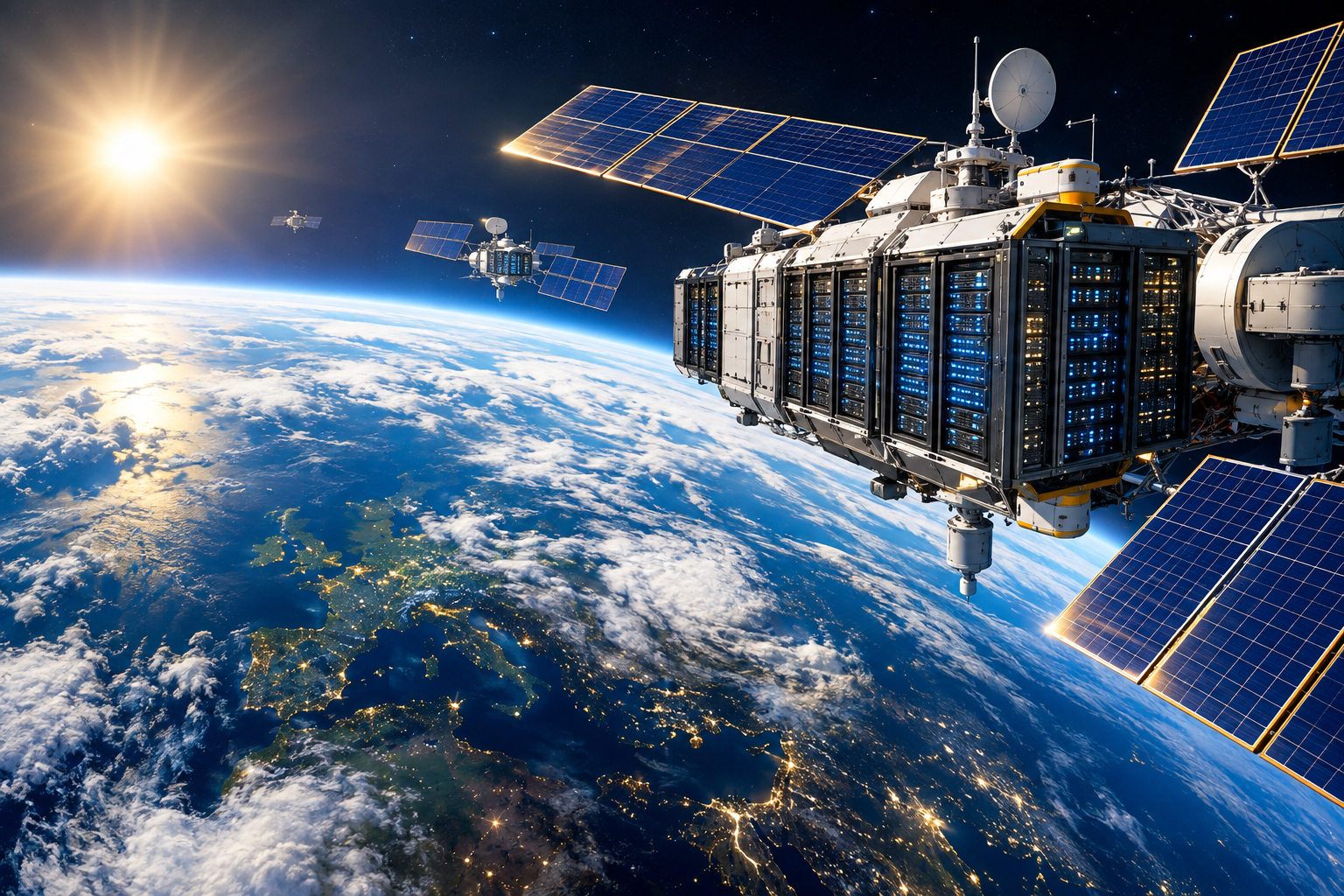
Could the computers of the future live above our heads? Explore how solar power, AI, satellites and orbital computing could create a new generation of data centres in space.
Leave a Reply