SEO title: The Butterfly Effect and Time Travel | Changing History
Meta description: What happens when a time traveller changes one tiny event? Explore the butterfly effect, alternate timelines and the consequences of changing history.
Keywords: butterfly effect, time travel paradox, changing history, alternate timeline, time travel
Category: Time Travel / Science
Tags: Butterfly Effect, History, Time Travel, Paradox, Alternate Timeline
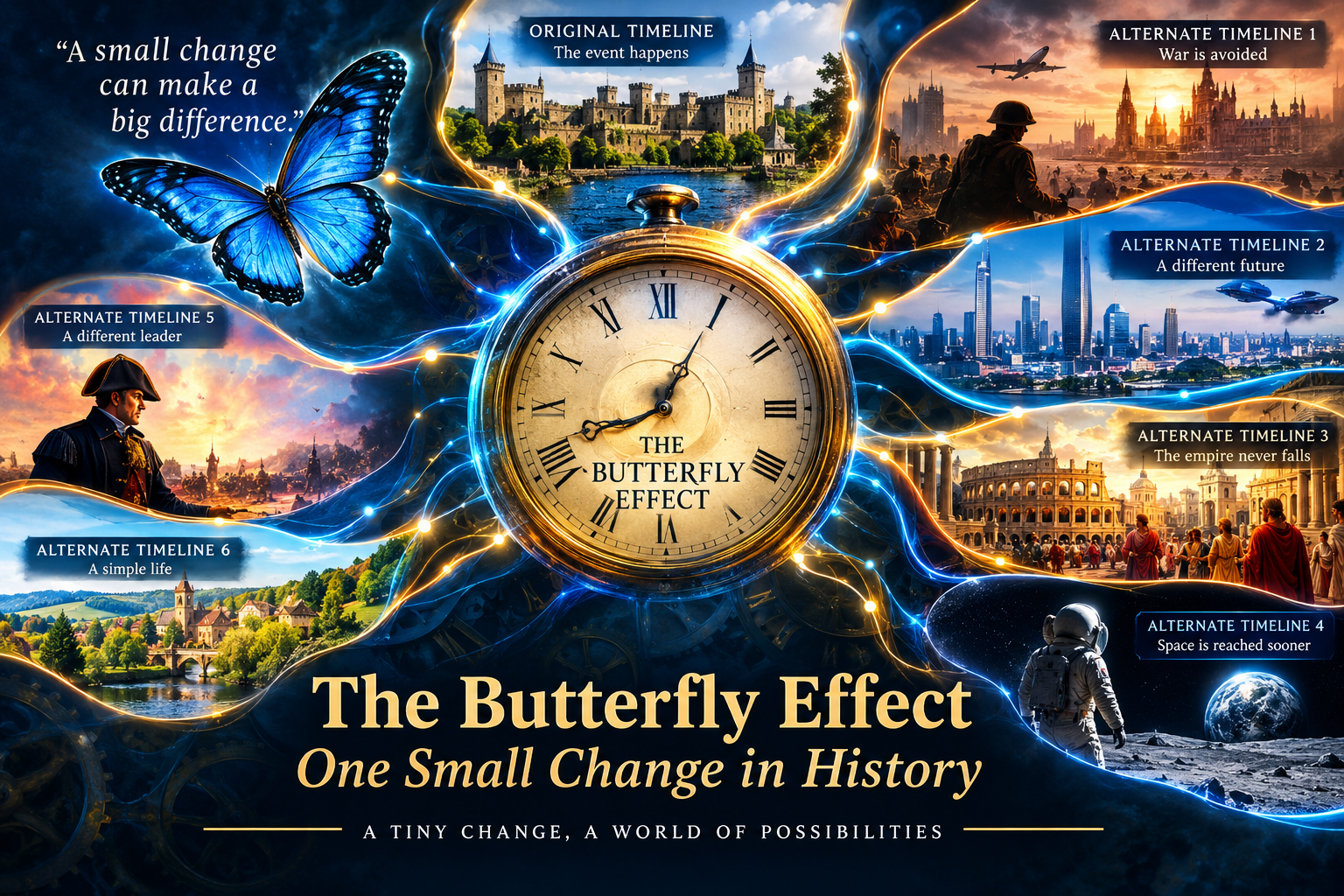
Suggested featured image: A clock surrounded by branching timelines, with each branch showing a different version of history
SEO Title: The Butterfly Effect and Time Travel | Changing History
Meta Description: What happens when a time traveller changes one tiny event? Explore the butterfly effect, alternate timelines and the consequences of changing history.
SEO Keywords: butterfly effect, time travel paradox, changing history, alternate timeline, time travel
Category: Time Travel / Science
Tags: Butterfly Effect, History, Time Travel, Paradox, Alternate Timeline
The Butterfly Effect: One Small Change in History
What if one tiny decision could change the entire course of history?

Imagine travelling back through time and making one tiny change. Perhaps you move an object, speak to a stranger, arrive five minutes earlier, or prevent an apparently insignificant event from happening.
At first, nothing seems particularly important. But what if that tiny change begins a chain reaction? What if one altered conversation leads to another decision, which influences another person, which eventually changes governments, technology, wars, discoveries or even the future of civilisation?
“A tiny change in the past could create a future that nobody recognises.”
This is the fascinating idea behind the butterfly effect and one of the most interesting questions in fictional time travel: what happens when history is changed?
What Is the Butterfly Effect?
The butterfly effect is associated with the study of complex systems and chaos theory. The basic idea is that a very small difference in the starting conditions of a system can eventually produce a dramatically different result.
The famous butterfly metaphor suggests that a tiny disturbance could contribute to much larger changes elsewhere. It is important to understand that the phrase is a metaphor rather than a claim that an individual butterfly literally causes a particular storm.
When applied to time travel, however, the concept becomes a fascinating storytelling device.
“Change one event and you may change everything that comes afterwards.”
One Small Change in History
Consider a fictional time traveller visiting a city hundreds of years in the past. They accidentally knock a letter from a table and place it somewhere else.
That sounds harmless. But imagine the letter contains information that changes someone’s decision. That person then makes a different journey. They meet someone else. A business is created. A scientific idea spreads to a different country. A political decision happens differently.
Hundreds of years later, the consequences could be enormous.
The Chain Reaction
- A time traveller makes a tiny change.
- Someone reacts differently.
- A second event changes.
- Other people make different decisions.
- The effects spread through society.
- Future events develop along a different path.
Could a New Timeline Be Created?
One popular idea in science fiction is that changing history does not overwrite the original timeline. Instead, it creates an alternate timeline.
In this version of the story, the original history continues to exist while the time traveller creates a new branch of events.
The result might look something like this:
Original Timeline
↓
One small historical change
↓
The original sequence continues
A new sequence develops
The Time Travel Paradox
Changing history creates another fascinating problem: the time travel paradox.
Suppose a traveller goes into the past and prevents an event that was necessary for the traveller’s own existence. If that event never happened, the traveller might never have been born. But if the traveller was never born, who travelled into the past and changed the event?
This kind of logical problem is one reason time travel has remained such a popular subject in science fiction.
“If you change the past, do you change your own future — or create another one?”
Six Possible Futures
In a fictional universe governed by the butterfly effect, a single historical change could lead to countless possibilities:
- A different leader: one altered meeting changes a political career.
- A different war: a decision made years earlier changes a conflict.
- A technological revolution: an invention is discovered decades sooner.
- A different empire: a kingdom survives when history originally said it would fall.
- A peaceful future: a conflict is avoided entirely.
- A completely unfamiliar world: the changes become so extensive that the original history is almost unrecognisable.
Is the Butterfly Effect Real?
The underlying scientific concept comes from the behaviour of complex systems, particularly the idea that some systems can be highly sensitive to their initial conditions.
That does not mean that time travel has been demonstrated or that humans can travel into the past and rewrite history. There is currently no established technology that allows people to travel backwards through time.
The butterfly effect therefore provides an intriguing bridge between real scientific ideas about complex systems and the imaginative possibilities of science fiction.
Imagine You Were the Time Traveller
Imagine standing in a historical town hundreds of years ago. You know exactly what is supposed to happen.
Then you notice a child about to drop a small object into a river. You could stop them.
Should you?
Perhaps the object seems worthless. Perhaps preventing its loss makes no measurable difference. But what if someone later finds it because it was dropped into that river? What if that discovery inspires an invention? What if the invention changes the world?
The time traveller can never know all the consequences.
“The greatest danger of changing history may be that you cannot see the history you are replacing.”
A World of Possibilities
The butterfly effect makes time travel fascinating because it turns history into a network of possibilities rather than a simple straight line.
One small decision could theoretically lead to another, then another, creating an entirely different sequence of events. In fiction, this gives writers the opportunity to explore alternate histories, paradoxes and futures that are radically different from our own.
Perhaps the most interesting question is not whether a time traveller could change history, but whether they would ever know exactly what their change had caused.
One moment. One decision. One tiny change — and an entirely different future.
cars (1) Causality (1) Clocker SAS (1) Featured (8) Future Computing (1) Grandfather Paradox (1) how time travel works (1) html (1) influence (1) is time travel possible (4) Java (8) Mission 2127 (1) Orbital Computing (1) planes (1) Project Suncatcher (1) python (9) python time travel (9) Quantum Realities: (1) Quantum Theory (1) science of time travel (16) Space AI (1) Space Technology (2) Timeline (1) time travel (18) time travel explained (14) time travel physics (3) time travel theory (12) trains (1) Unraveling the Mysteries of Modern Physics (8)
- Category 1 (1)
- Category 2 (1)
- Category 3 (1)
- New time-travel.space (20)
- Time Travel (18)
- Quantum Theory (1)
- Science & Technology (16)
- Time Travel (18)
-
The Butterfly Effect: One Small Change in History
The Butterfly Effect
Leave a Reply